search

Wednesday, 20 March 2013

Tibet among world's most repressed societies


Repression in Tibet
WASHINGTON: Expressing concerns about the continuing unrest in Tibet and the tragic trend of self-immolations, a top US senator has alleged that the region is among the most repressed and closed societies of the world. 

"Tibet today is one of the most repressed and closed societies in the world, where merely talking on the phone can land you in jail. Support for the Dalai Lama can be prosecuted as an offence against the state,"Senator Robert Menendez, Chairman of the powerful Senate Foreign Relations Committee said. 
"Tibetans are treated as second class citizens; their travel within and outside of Tibetan areas is highly restricted. Foreign diplomats and journalists are routinely denied access," he said on the Senate floor yesterday. 
Since February 2009, more than 100 Tibetans have set themselves on fire, he noted. 
Many of the self-immolators have called for the return of the Dalai Lama to Tibet and for China to acknowledge the basic human dignity of the Tibetan people. 
"Like so many others, I wish that Tibetans would not choose self-immolations, a horrific act, as a method of protest. I hope Tibetans will find other ways to express their grievances and despair and halt these self-destructive acts," he said. 
"At the same time, we must understand that these sorts of acts are indicative of the deep sense of frustration felt by the Tibetan people. This is not a conspiracy of "foreign forces" but indicative of the deep sense of hopelessness of a people denied their basic dignity," Menendez said. 


He observed that Americans see Tibet as an issue of fundamental justice and fairness, where the fundamental human rights of the Tibetan people, as embodied in the Chinese constitution, are not being respected; where their culture is being eroded; and where their land is being exploited. 

Menendez said thus the responsibility falls to the US to help the Tibetan people in their efforts to preserve their culture and identity and have a say in their own affairs and to be able to exercise genuine autonomy within China. 
"We should continue to fund the important programmes that help Tibetan communities, both in exile and on the Tibetan plateau. While these provide tangible humanitarian results, they also send a critical signal to the aggrieved Tibetan population that the United States hears their plea," he said. 
The United States, he said should work with the UN to secure access to Tibet for independent international observers and media members. 
"The State Department should continue to insist on access to Tibet by its personnel. We need independent and credible reporting on the true situation on the ground, and the Department should work with China to take steps to see that the principle of reciprocity is respected," Menendez argued. 
"Peaceful resolution of the Tibet issue could go a long way in demonstrating to the world that China is indeed a responsible and constructive member of the community of nations. In turn, Beijing's growing influence in the Himalayan belt, especially Nepal, should be assessed in a broader dialogue with other nations in the region," Menendez said.


shared from Economic times
Sunday, 17 March 2013

Xi Jingping first speech: "I will be true to the responsibility given to me"


The new Chinese President, Xi Jinping, has said he will fight for "the great renaissance of the Chinese nation," in his first speech as head of state.

"Good day, ladies, gentlemen, and friends. Sorry to have kept you waiting. I am very happy to meet with you, friends of the press.
Yesterday, the 18th CPC [Communist Party of China] National Congress victoriously concluded.
During these days, friends of the press have made lots of coverage on the congress and conveyed China's voice in abundance to every country around the world. Everyone has been very dedicated, professional and hardworking. For this, on behalf of the Secretariat of the 18th Party Congress, I would like to express sincere gratitude to you.
Just now, we have conducted the first plenary meeting of the 18th CPC Central Committee and elected the new central leadership organisation during the meeting. The plenary meeting election has produced seven Standing Committee members of the Political Bureau and elected me as the CPC General Secretary.
Here, let me introduce to you my colleagues, the other six Standing Committee members. 
They are: Comrade Li Keqiang, Comrade Zhang Dejiang, Comrade Yu Zhengsheng, Comrade Liu Yunshan, Comrade Wang Qishan, and Comrade Zhang Gaoli. 
Comrade Li Keqiang served as a Standing Committee member of the Political Bureau of the 17th CPC Central Committee while other comrades served as members of the Political Bureau of the 17th CPC Central Committee. You have known them well.
Here, on behalf of the members of the new central leadership organisation, I sincerely thank all comrades of the party for their trust in us. We will live up to the great trust placed on and the mission assigned to us. 
The great trust of all members of the party and the expectations of people of all ethnic groups around the country are not only a tremendous encouragement to our doing the work well, but also a heavy burden on our shoulders. 
This great responsibility is the responsibility to our nation. Our nation is a great nation.
During the civilisation and development process of more than 5,000 years, the Chinese nation has made an indelible contribution to the civilisation and advancement of mankind. 
In the modern era, our nation experienced constant hardship and difficulties. The Chinese nation reached the most dangerous period. Since then, countless people with lofty ideals to realise the great revival of the Chinese nation rose to resist and fight, but failed one time after another. 
Since the founding of the CPC, we have united and led the people to advance and struggle tenaciously, transforming the impoverished and backward Old China into the New China that has become prosperous and strong gradually. The great revival of the Chinese nation has demonstrated unprecedented bright prospects.
Our responsibility is to unite and lead people of the entire party and of all ethnic groups around the country while accepting the baton of history and continuing to work for realising the great revival of the Chinese nation in order to let the Chinese nation stand more firmly and powerfully among all nations around the world and make a greater contribution to mankind.
This great responsibility is the responsibility to the people.
Our people are a great people. During the long process of history, by relying on our own diligence, courage and wisdom, Chinese people have opened up a good and beautiful home where all ethnic groups live in harmony and fostered an excellent culture that never fades. 
Our people love life and expect better education, more stable jobs, better income, more reliable social security, medical care of a higher standard, more comfortable living conditions, and a more beautiful environment.
They hope that their children can grow up better, work better and live better. People's yearning for a good and beautiful life is the goal for us to strive for.
Every bit of happiness in the world has to be created by diligent work and labour. Our responsibility is to rally and lead the whole party and all of China's ethnic groups and continue to emancipate our way of thinking, insist on reform and opening up, further unleash and develop social productive forces, work hard to resolve the difficulties faced by the masses in both production and life, and steadfastly take the road of common prosperity.
This is a major responsibility towards the party. Our party is a political party that serves the people wholeheartedly. The party has led the people in scoring accomplishments that capture the attention of the world. We have every reason to be proud. However, we are proud but not complacent, and we will never rest on our laurels.
In the new situation, our party faces many severe challenges, and there are many pressing problems within the party that need to be resolved, especially problems such as corruption and bribe-taking by some party members and cadres, being out of touch with the people, placing undue emphasis on formality and bureaucracy must be addressed with great effort.
The whole party must be vigilant.
The metal itself must be hard to be turned into iron. Our responsibility is to work with all comrades in the party to be resolute in ensuring that the party supervises its own conduct; enforces strict discipline; effectively deals with the prominent issues within the party; earnestly improves the party's work style and maintains close ties with the people. So that our party will always be the firm leadership core for advancing the cause of socialism with Chinese characteristics.
It is the people who create history. The masses are the real heroes. Our strength comes from the people and masses. We deeply understand that the capability of any individual is limited, but as long as we unite as one, there is no difficulty that we cannot overcome. Individuals have limited time in work, but there is no limit in serving the people wholeheartedly.
Our responsibility is weightier than Mount Tai, and our journey ahead is long and arduous. We must always be of one heart and mind with the people; share weal and woe with the people; make concerted and hard effort with the people; attend to our duties day and night with diligence; and strive to deliver a satisfactory answer sheet to history and the people.
Friends from the press, China needs to learn more about the world, and the world also needs to learn more about China. I hope you will continue to make more efforts and contributions to deepening the mutual understanding between China and the countries of the world.
Thank you everybody!"

Thursday, 14 March 2013

Memories of 2008 Riots in Tibet Fading Away: Chinese Legislators


As Tibet observes the fifth anniversary of Lhasa riots tomorrow amid self immolation protests against Chinese rule, legislators of the ruling Communist Party said memories of the 2008 riots, which shook the Himalayan region, has faded out.

"The memory of it is thin and the psychological pressure has been alleviated. Everyone is focusing on making life better," Padma Chodron, a legislator from Tibet, said referring to the violence that erupted in Lhasa on March 14, 2008, resulting in the deaths of 19 people.

However, she says she can still feel the fear when the images of looting and violence were shown on television in her home village.

"I was fidgety day and night, afraid that something terrible would happen again," the Tibetan deputy currently attending the Chinese Parliament -- the National People's Congress (NPC) -- told state-run Xinhua news agency.

"Conversations between villagers were limited to everyday things, but after the incident, the topics changed and our peaceful lives were disturbed," the deputy from Medog county said.

The riots in which hundreds of Buddhist Monks took part shook China and the world and the Chinese Premier Wen Jiabao blamed the supporters of the Dalai Lama based abroad for instigating the violence ahead the 2008 Beijing Olympics.

The incident also had an impact on the region's tourism industry, which many depend on to secure their livelihoods.

In 2008, the volume of tourists was reduced to less than half of that of the previous year. The tourism boom brought about by the inauguration of the Qinghai-Tibet railway in 2006 came to an end after the incident, the Xinhua report said.

Five years after the riot, Tibetans attending the annual meeting of the Parliament believe the memory of the incident has passed.

"Tibet has long been out of the shadow of the incident," said Xindra Tenzin Chodrak, the deputy director of the standing committee of the people's congress of Tibet.

"Businessmen and Buddhists tell me they feel safe in Lhasa," Xindra claimed skirting any references to over 100 self immolations in the Himalayan region protesting the Chinese rule.

The regional tourism industry, mainly boosted by the arrivals from Chinese main land began to recover in 2009, with the number of visitors reaching 5.56 million in 2009 and over 10 million from home and abroad last year.

"To maintain Tibet's social stability, it is important to develop the economy and improve people's livelihoods," said Padma Choling, the director of the standing committee of the people's congress of Tibet.

Over the past five years, Tibet has maintained GDP growth of 12 per cent, as well as boosted incomes for both urban and rural residents, he said.


shared from OUTLOOK India

Wednesday, 13 March 2013

Tibetan Uprising Day Reminds Us


More than a half century ago, on March 10th, 1959, Tibetans revolted against the Chinese military occupation of Tibet that began in 1951. The revolt ended badly for the Tibetans who suffered from a brutal Chinese crackdown. This caused the Dalai Lama, with the help of the CIA, to flee with his supporters to India. On March 31, 1959, after a grueling 15-day journey across the Himalayas on foot, the Dalai Lama escaped from the Chinese and crossed over to India along with 80,000 Tibetans. Ever since then, March 10th has been commemorated as Tibetan Uprising Day with worldwide protest marches to mobilize support for the Tibetan cause.
Even as desperate self-immolations among Tibetans still living in Tibet have increased in the past few years, there seem to be no signs whatsoever of China relenting on its cultural genocide there. At a time when movements like the Arab Spring get mainstream media attention, it is unfortunate that the struggle of the Tibetans seems to be slipping from public consciousness.
Unlike the hot spots of the Middle East, Tibet lacks a natural resource like oil that powerful nations would fight over. The peaceful nature of the Tibetan struggle, unlike agitations in the Islamic world, has certainly generated goodwill for the Tibetans. But since they do not pose a security threat to the rest of the world as exporters of terror or nukes, it seems safe to simply look the other way. China's growing clout and persistence has gradually worn down the uprising, and Tibetans' support base among Western leaders is muted. Tragically, today's youth in the West seem generally less passionate to get involved than the youth of the 60s.
One wonders what lies in store for this movement. With the Dalai Lama aging, the Chinese know that time is on their side and are willing to wait it out. Without a new Tibetan leader of comparable charisma, they hope to accentuate internal clashes among rival Tibetan groups, offer carrots to some ambitious leaders, and use classic divide-and-conquer tactics to finish off the movement. Meanwhile, in Tibet, the land and sacred geography are being rapidly turned into secular tourist attractions under the ultimate control of the communists, and repopulated by the ethnic Han Chinese. Tibetan culture is becoming transformed by China, and "digested" into Mandarin identity.
While this should be a concern for the entire world, India and the U.S. should worry the most. India's mightiest rivers (Brahmaputra, Ganga and Indus) all originate in Tibet, and China has started an ambitious project of rapidly building at least 20 hydroelectric dams in Tibet, each with the potential to divert water away from India and into China. Quenching China's thirst will come at the expense of India where droughts will result in many areas. I had predicted this scenario many years ago before it was fashionable to consider it, but only recently has this suddenly become a hot topic.
Tibet is also the military base for China's nuclear arsenal aimed at India, giving China the ability to reach India within minutes from launch. Tibet is the route through which the China-Pakistan links are transporting military and other goods through modern highways, railroads and pipelines. This enables China to gain access to the Indian Ocean ports that are located in Pakistan, and Pakistan gets instant assistance from China in any conflict with India. Indeed, if Tibet could be neutral, autonomous and demilitarized, the India/Pakistan security situation would have the potential to be more easily resolved as a bilateral rather than trilateral one.
For the United States, China is its main rival and competitor in all spheres, a fact known and understood to both. While China has never hid its intentions, the U.S. has lacked a determined plan to address this. Tibet is China's path for the critical trade routes of the Indian Ocean, the Central Asian oil and gas reserves, and the rich ASEAN countries to the south.
As an example of its myopic foreign policy, the U.S. isolated Myanmar for many years on the grounds of human rights violations, which hurt mostly the poor people of Myanmar rather than the military junta. This played right into the hands of the Chinese. Had the improvement of human rights been the honest motive, the U.S. would have adopted similar measures against China where the human rights violations have been on a far larger scale. Myanmar was simply an easy target to get rid of American guilt and to show muscle. Thus China got a decade of monopoly in Myanmar which it used to solidify long term strategic control over Myanmar's resources and privileged access routes to the Indian Ocean. Tibet is again strategically located to make this possible.
The Tibetans themselves can also do much more than they have. For one thing, they must urgently initiate the rise of a new face on the world stage under the mentoring of the Dalai Lama. The Karmapa is one such young, charismatic leader with a deep grounding in Indo-Tibetan Buddhism and sharp intellect. Unfortunately, he remains largely confined in India. According to some sources, the Indian government is unsure if he a Chinese plant -- like a Manchurian Candidate. This matter needs to get urgently resolved rather than after the Dalai Lama is gone from the scene. It is best to let the next generation of leadership become active internationally, and be tested in all respects while the Dalai Lama is able to mentor and watch over the transition.
We should not count on a change of heart among the next generation of Chinese. For China has done a good job in its education system to indoctrinate its youth to view Tibet as an integral part of China, and to demonize the independence movement as a conspiracy by hostile foreign powers with the top Tibetan leaders as co-conspirators.
The odds against Tibet are indeed heavy on such a loaded chessboard. But many other struggles also seemed hopeless in the past. I wish the Tibetan movement finds new champions among the youth of all countries.

Rajiv Malhotra


Xinhua:Tibet to build first genetic resource bank


LHASA, March 13 (Xinhua) -- Southwest China's Tibet Autonomous Region will start construction on its first genetic resource bank within the year, regional authorities said Wednesday.
The bank will help Tibet protect its genetic resources and ensure sustainable conservation, according to the regional science and technology department.
The bank will be used to preserve plant seeds, as well as DNA from animals and microorganisms.
Tibet's biodiversity is abundant, but its environment is relatively fragile, said Li Hui, a researcher from the Institute of Tibetan Plateau Research under the Chinese Academy of Sciences.
The bank will help to ensure the continuation of some species for further study, as well as aid in breeding research for endangered species, Li said.
Tibet is home to more than 9,600 plant species, including 855 species that are unique to Tibet. The region also has 800 species of wild vertebrates, 123 of which are under national-level protection.

Tuesday, 5 March 2013

Britain's Relationship with Tibet: History tells it all!


The first Britain or British-India's relationship with Tibet began after her losing of trade ties with Nepal in the aftermath of rise of Gorkha rule in Nepal in 1769 AD. Almost at the same time, Sir Warren Hastings, the first Governor-General of British India, after the British East India Company came under the direct rule of British Queen, sent George Bogle in 1774 AD, and Samuel Turner in 1783 AD, looking for trade relationships with Tibet. At that time, the Britain and British-India already had trade relationships with China through the East coast. The fact that British India did not related to China for seeking trade ties with Tibet, showed the lack of China's suzerainty, leave alone sovereignty over Tibet. Tibet refused to accept for trade, countries other than the customary ones like Nepal, Sikkim, Bhutan, Nepal, Mongolia, Turkestan and others.
Owing to recent conflicts with Nepal in 1788 AD and 1791 AD, and at the advice, very likely given at an earlier time, by the Gorkha new King Prithvi Narayan Shah, Tibet refused to open herself to distant foreign countries, or she adopted a policy of seclusion. After the Britain's Opium wars with China, she began to lose interests in Nepal, and at the same time, proportionally built up the good relationship with China which culminated in Britain's receiving China's support for annexation of Burma. Besides this, as seen in the 1890 and 1893 treaties, undue commercial and political supports in violation of Tibet's sovereign authority, came to be received by the British-India from China. As it was secretive and failed to receive the Tibet's acceptance, it led to the British 1904 Expedition coming into Lhasa, and a treaty signed between the Tibet's government and the British-India. As the military expedition failed to comply with the real policy of British government in London, and also because of the lack of Tibetan acceptance of 1893 treaty, the British government in 1906 AD, signed a treaty with China which was to further the Britain's long-cherished trade interests in Tibet.
In 1907 AD, Britain signed a treaty with Russia which also did not fail to include China as a way of dealing with Tibet for the relationship. This treaty, in spite of being a method to keep peace in surrounding countries and stop expansionist attempts, ensured the British India's wish for keeping trade relationship with Tibet uninterrupted. The fact came to the forefront in the 1908 treaty with representatives from China, and also from Tibet, who had been rather forced, which carried a clear recognition by Britain of the China's suzerain authority over Tibet, to facilitate her trade. But in all likelihood, this and the earlier treaties with China, were due to Britain's lack of knowledge that Tibet and China enjoyed only patron-priest relationship which even cannot be termed as China's suzerainty power over Tibet. Yet, politically, it beckoned the Chinese troops which in 1910 AD reached Lhasa, militarily unopposed, because of an act of diplomacy, as the Dalai Lama was in exile in those years.
As the coming of such troops into Lhasa was unprecedented in Tibet's history, it started off the Tibet's request for assistance from an outside country, i.e, British, who also was clearly disillusioned and already fallen in the trap of earlier treaty signed with China, for direct intervention for seeking the withdrawal of Manchu troops from Tibet. But the request for seeking the outster of Chinese troops could not be fulfilled at first. Since that time, Tibet also began to assert her independence from China, and never on any earlier occasion in history, as few writers on Tibet claimed it to be so. The Chinese troop's invasion and Manchu Emperor's inability to drive them out, and the Lhasa Amban's repeated attempt at having more troops to invade Tibet, during the 13th Dalai Lama's visit to China in 1909, caused the first rift in Emperor's act of patronage, as existing between Tibet and Manchu China.
In 1913 AD, the Britos tried to remove the differences between Tibet and China, who saw the downfall of Manchu Dynasty in 1911 AD, and was then under the Nationalist rule. But the Simla Treaty, for having China to accept it, failed, because of the claim of just the territory earlier occupied by Chao Erfeng's troops, and the Tibetan and British representative's unwillingness to change the provisions of the treaty. And so an attempt to restore the past patron-priest relationship with Tibet by the Chinese new Nationalist regime but having a link with the earlier Manchu Dynasty failed miserably. Even at that time, the lack of China's claim of sovereignty over Tibet can be seen absent, while offer for suzerainty over Tibet was not acceptable to them. Britain and Tibetan representatives also signed a trade treaty at that time, thus building a relationship between the two countries for the coming years. 
Source: Phayul

A senior Tibetan Monk imprisoned by China


A Chinese court on Friday sentenced a senior Tibetan Buddhist monk to one year and three months in prison for his alleged involvement in the self-immolation protests against Chinese oppression in Tibet.
On March 1, 2013, (Afternoon) a local Chinese 'Intermediate People's Court' has sentenced the 42-year old Tibetan monk to one year and three months in prison. Sources told The Tibet Post International that the "Yarphel is a respected senior Tibetan Buddhist monk of Yershong Monastery in Rebkong county of eastern Tibet."
Dorjee Lhundup, a 25-year-old Tibetan, set himself on fire on November 4, 2012 in Rebkong, Amdho region of eastern Tibet. The Chinese security forces attempted to force their way towards the body in an effort to remove his remains from the site.
Lhundup died at the scene, and his body was protected by local Tibetans and monks, who cremated it and returned the ashes to his hometown. The local Tibetans at the scene reportedly have taken the young man's body to nearby Rongwo Monastery in Rebkong.
"Ven Yarphel was charged over accusation of taking part in carrying Lhundup's ashes from Rongpo Monastery to his home-town. He is originally from Dragkar village in Rebkong, Malho of eastern Tibet and his father name is Lhubum Gyal," the sources added.
Their trial, as per usual, took place behind closed doors and in secrecy. According to our sources inside Tibet.
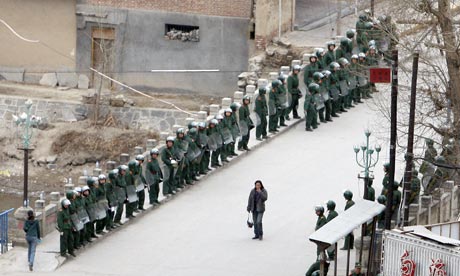
A number of recent photos coming from Tibet showing heavy armed Chinese military presence in Rebkong and surrounding areas, according to sources, that has been increasingly deployed after and during Losar religious festivities.
Over 107 Tibetans- including monks, nuns, students and lay people - have set themselves on fire in Tibet since 2009 and most of them have reportedly died.
The most common call for the return of the spiritual leader His Holiness the Dalai Lama, the preservation of the Tibetan language, and an end to restrictions on freedom of religion. However, many also called for Tibetan independence.
In the severe crackdowns in Tibet, authorities in Beijing still believe use of heavy imprisonments is the only and best way to stop the massive wave of self-immolation protests that has records as the largest in human history.
"We remain concerned by the deteriorating human rights situation in Tibetan areas, including the numerous tragic self-immolations that have occurred and related reports of detentions and arrests," US State Department acting deputy spokesman Patrick Ventrell told reporters on Friday, during his daily press briefing.
"We've also seen, as you mentioned, in Nepal, self-immolations. We continue to call on the Chinese Government to permit Tibetans to express grievances freely, publicly, peacefully, and without fear of retribution. And we urge Tibetans to end self-immolations.," he added.
Above is an article published by The Tibet Post International:

Tuesday, 26 February 2013

Life in Exile


Exile refers to an enforced expulsion from one's native country either by one's own will or by someone else due any political or social instability. So is the case with the Tibetan people. Tibet has been claimed to be a part of China by Chinese which the Tibetans do not accept with the perfect reasons of unique national identity. There is no enough evidence from the part of Chinese government to convince the world of their claim over Tibet but with the forced statements against the Tibetan fight for the Tibetan nationality formed from mistakes in regard with a third person's own national stake like the honorable Jawaharlal Nehru are though well known lies, which can not last any longer with time. However, the situation now is carried on by such wind of absolute force of control in disregard to all national and international laws, humanitarian norms and hence, this rendered a large number of Tibetans homeless and desolate in the diaspora of foreign world.

I was born very much later after the formation of the Tibetan exile community and I was too born in Tibet under a larger controlling government, arrived several decades ago. Though the histories are just stories, they can still create a huge difference to the present life and that is what made the Tibetans abandoned from each other. Though the true history of the two nations, Tibet and China share a distinct relationship that would be between any two countries, Tibet however became a victim of a conquest at a time of economic boom. May be it was in the fate of the Tibetan people to face this brutal repression but it is obvious that this will not last for ever. The opportunity that the weak Tibetan nation presented for colonialism not so long after the end of colonialism from the European powers, the opportunist Chinese regime under the leadership of Mao ventured into the forbidden world of Tibet knowing the opportunity as well as the difficulties onward. However hard it might had been for the communist army then, they were extremely benefited by the situation of Tibet at that time; with the lack of consolidated national framework of government throughout the whole stretch of Tibet and incompetent defense network as well as strategical office of government to take the responsible too. The too sensitive nature of Tibetan culture and traditions too came extremely handy for the invaders then. The state of being of Tibetan country, almost cut out from other parts of the world became the main course of this conquest of power.

The outcome is clearly visible today. With His Holiness the 14th Dalai Lama fleeing to India for exile, a new turn for the fight back was born. A large number of Tibetans also started taking it to exile after His Holiness and a new world of exile life was born after 1959. The fight against the giant China over the return of Tibetan People's authority never came handy despite the strong support from various governments and other influences across the world. So the exile society kept growing on and on...
Today, it is the year of 2013, about 54 years past the first arrival of Tibetans to exile with no clear sight to how long it is going to last! Many people have merged their bodies into the earth with their larger family members still longing for a reunion out there in Tibet. While there are also a very large number of Tibetans who are born outside Tibet with the eligibility for a citizenship of the country there. But there is the dilemma with oneself there, how can you accept that citizenship? The bones and the flesh are of pure Tibetan person but with a document describing someone else! And then there are people like me in the exile community, not belonging to a proper family in the sight, yet always need to go on with the same situation; no place to return home in the end of the day, no family members to live along with every passage of day and week, no proper community to survive in so comfortably! This is the life in exile.

There is a world around with people in the race for achievements of their personal goals with perfect identity but the Tibetans are still fighting on with their common goal of returning to a free Tibet. With no proper identity and entitled rights, the personal dreams and goals of a Tibetan kid has so commonly remained the same throughout their life! I can't agree with the reasons like incompetency of Tibetans in achieving their goals because we are as much human as any other people around us in this foreign world here. Only the difference is that they have a society passed on from generations, a family to grow with so freely and closely, a nation in which you can live to become the president of it!
Human emotions are to a great extend instinct and however strong you are able to tame your mind over your emotions, it is hardly in your control!

Monday, 18 February 2013

102nd Burning Tibetan from Tibet:RFA


A Tibetan man set himself on fire in China’s Gansu province Sunday in protest against Chinese rule in Tibet, bringing the total number of Tibetan self-immolations to 102, sources said.

Namlha Tsering, 49, also known as Hoba, carried out his protest in the middle of a busy street in the seat of Sangchu (in Chinese, Xiahe) county in the Kanlho (Gannan) Tibetan Autonomous Prefecture, a source inside Tibet told RFA’s Tibetan Service.

“Today, Feb. 17, a Tibetan named Namlha Tsering self-immolated in the downtown area of Sangchu county in protest against Chinese policy in Tibet,” said the source, who spoke on condition of anonymity.

“He was a resident of Gengya township, an affiliate township of the Labrang monastery in Kanlho prefecture in Gansu.”

The burning marked the second in Sangchu county in days.

On Wednesday, Drukpa Khar, 26, died after dousing himself in gasoline and setting himself alight in Achok town in Sangchu.

Photos sent to RFA by a source from the area showed Namlha Tsering’s body engulfed in flames as he sat cross-legged in a roadway with cars passing by him.

Later photos show Chinese security personnel surrounding the area where his body had lain, ashes clearly visible on the ground.

Namlha Tsering’s condition was unknown Sunday, but reports said that he was unlikely to have survived the ordeal and that he had been bundled away by Chinese authorities.

The London-based Free Tibet advocacy group said in a statement Sunday that eyewitnesses had described Namlha Tsering as being "severely burned" in the protest and said that he had been taken away by security forces who subsequently stated that he had died.

Free Tibet said that Namlha Tsering has a wife and four sons, the oldest of whom is a monk.

His protest comes on the fifth day of the traditional Tibetan Losar New Year, which has been marked this year by most Tibetans with prayers for compatriots who burned themselves to death during the year to challenge Chinese rule.

The latest incident raised the self-immolation toll to 102 despite Chinese government moves to detain, charge, and jail Tibetans over suspected roles in the burnings or other protests questioning Beijing’s rule in Tibetan-populated areas and calling for the return of Tibet's spiritual leader the Dalai Lama.


Blame 

Beijing has defended its rule of Tibet and says the Dalai Lama and other Tibetan leaders in exile have orchestrated the self-immolations from their base in India.

But Tibetan exile leaders deny involvement in the burnings and have called on Tibetans in Tibet to exercise restraint.

At least 15 Tibetans, including monks, have been jailed in recent weeks in connection with the self-immolations. Some were handed sentences of up to 13 years.

Rights groups have condemned the Chinese authorities for criminalizing the burning protests and cracking down on Tibetans who are seen to have provided encouragement or support.

In addition to the harsh sentences, Chinese authorities have also deployed paramilitary forces, shut down communications and restricted travel in the areas where self-immolations have occurred.

Stephanie Brigden, director of Free Tibet, said that the burning protests had continued, despite the tough new measures Beijing had introduced in the region.

“During November when the Chinese leadership transition took place, self-immolation protests were an almost daily occurrence. Since then, China has introduced a slew of new repressive measures in an attempt to stop them," she said.

"It is now clear that there are still Tibetans willing to undertake this most extreme form of protest and just as importantly, other Tibetans willing to risk the wrath of the state by reporting their actions to the outside world.”

The U.S. State Department on Friday noted the “horrific figures” of burning protests in Tibet and expressed deep concern over the self-immolations.

“We call on those who are immolating or those who might be considering this to think hard about whether it’s the best way to express yourself,” department spokesperson Victoria Nuland said.

“And we also, as we always do, call on the Chinese Government to address its own policies in Tibet that have caused these kinds of tension and frustration.”

shared from RFA

Thursday, 14 February 2013

China blocks Aussie official's Tibet visit


AUSTRALIA'S top diplomat in China has been unable to win Beijing's permission to visit Tibet after almost a year of trying.
Foreign Minister Bob Carr announced in March 2012 that Ambassador Frances Adamson would seek to travel to Tibet to talk to locals and look into why a growing number of Tibetan pro-independence protesters were setting themselves on fire.
"Unfortunately I'm not able to share encouraging news," Senator Carr told a Senate estimates hearing in Canberra on Thursday.
Ms Adamson had made several requests but so far to no avail.
"I regret that I can't report progress," he said.
Department of Foreign Affairs and Trade Secretary Peter Varghese said Australia believed there have been at least 98 self-immolations in the past two years.
"We have consistently conveyed to the Chinese authorities our concern about the situation," he said.
He revealed in October that top Australian officials had visited China to push for more regular formal meetings between Canberra and Beijing.Senator Carr said Australian plans to boost diplomatic ties with China was effectively on hold until after its leadership transition is finalised in March.
Such an arrangement would be similar to those Australia already has in place with countries like the US, but Beijing is yet to respond to the proposal.
The new arrangements could include annual meetings between the Australian prime minister and Chinese president, as well as separate meetings between foreign and economic ministers.

Monday, 7 January 2013

Chinese journalists protest censorship


Jan 7, 2013, 03.41PM IST Reuters

GUANGZHOU: Scores of supporters of one of China's most liberal newspapers demonstrated outside its headquarters on Monday in a rare protest against censorship, backing an unusual strike by journalists against interference by the provincial propaganda chief.

The protest in Guangzhou, capital of southern Guangdong province, comes amid an escalating standoff between the government and the people over press freedom. It is also an early test of Communist Party Chief Xi Jinping's commitment to reform.

The outcry began late last week after reporters at the influential Southern Weekly newspaper accused censors of replacing an original New Year's letter to readers that called for a constitutional government with another piece lauding the party's achievements.

Police allowed the demonstration outside the headquarters of the Southern Group, illustrating that the Guangdong government, led by newly appointed and rising political star Hu Chunhua, wants to tread carefully to contain rising public anger over censorship.

The protesters, most of them young, laid down small hand-written signs that said "freedom of expression is not a crime" and "Chinese people want freedom". Many clutched yellow chrysanthemums, symbolising mourning the death of press freedom.

"The Nanfang (Southern) Media Group is relatively willing to speak the truth in China so we need to stand up for its courage and support it now," Ao Jiayang, a young NGO worker with bright orange dyed hair, said.

"We hope that through this we can fight for media freedom in China," Ao said. "Today's turnout reflects that more and more people in China have a civic consciousness."

The attention paid to the protest domestically highlights the unique position of Guangdong, China's wealthiest and most liberal province and the birthplace of the country's "reform and opening up" programme. In a symbolic move, Xi chose to go to Guangdong on his first trip after being anointed party chief in November.

On Sunday night, the Southern Weekly official microblog denied the removal of the New Year Letter was due to censorship, saying the "online rumours were false". Those remarks drew criticism from Chinese internet users.

Many Southern Weekly journalists disavowed themselves from the statement on the microblog, which they say was taken over by management, and pledged to go on strike the next day.

Several open letters have circulated on the internet calling for the Guangdong propaganda chief, Tuo Zhen, to step down, blaming him for muzzling the press.

Photographs on microblogs showed banners that said "if the toxin of Tuo isn't removed ... Guangdong will be castrated."

"Not since the time of reform and opening up and the founding of China has there been someone like Tuo Zhen," Yan Lieshan, a retired veteran editor at Southern Weekly, said. "He's too arrogant, he has gone overboard and constantly violates regulations."

Xiao Shu, a former prominent commentator at the Southern Weekly newspaper, said Tuo required that journalists submit topics for him to approve and yanked issues that he disliked.

"These details illustrate one problem: that he has established within the Guangdong media a system of prior censorship of the press," Xiao said, calling for Tuo's removal.

Chinese internet users already cope with extensive censorship, especially over politically sensitive topics like human rights and elite politics, and popular foreign sites Facebook, Twitter and Google-owned YouTube are blocked.

China shut the website of a leading pro-reform magazine on Friday, apparently because it ran an article calling for political reform and constitutional government, sensitive topics for the party which brooks no dissent.

adapted from TOI

Friday, 28 December 2012

China seizes TVs, satellite equipment in Tibetan area


A report found on the yahoo news which provided clear media report but still mixed some unrealistic statures of mentioning the true truth:
BEIJING (Reuters) - Chinese authorities have confiscated televisions from 300 monasteries in a heavily Tibetan part of the west of the country and dismantled satellite equipment that broadcast "anti-China" programs, prompted by Tibetan self-immolations in the region.
Some 94 Tibetans, including 81 this year, have set themselves on fire in protest against Chinese rule. Five self-immolations occurred in Tibetan-dominated Huangnan prefecture in Qinghai province, the state-run Qinghai news agency said on Thursday.
The government in Huangnan said its approach in tackling self-immolations comprised of "guiding public opinion on the Dalai issue", increasing patrols and "blocking outside harmful information", according to the news agency, which is managed by the Qinghai government.
"At this critical moment for maintaining social stability in Huangnan prefecture ... (we must) strengthen measures and fully fight the special battle against self-immolations," the article said.
"We do not know anything about it," an official from the Huangnan prefecture government told Reuters by telephone, when asked to confirm the report, before hanging up.
Beijing considers Nobel peace laureate the Dalai Lama, who fled China in 1959 after an abortive uprising against Chinese rule, a separatist. The Dalai Lama says he is merely seeking greater autonomy for his Himalayan homeland.
The article said the prefecture's agricultural and pastoral areas had relied on certain satellite equipment"to watch and listen to overseas, anti-China programs".
The local government would invest 8.64 million yuan ($1.39 million) to install 50 transmitters that would broadcast 70 percent of the prefecture's television channels, the report said.
China has repeatedly denounced the Dalai Lama and exiled Tibetan groups for fomenting the self-immolations.
The United States and several other countries have called on China to end repressive policies and to negotiate with the Dalai Lama.
Beijing has defended its iron-fisted rule in Tibet, saying the remote region suffered from dire poverty, brutal exploitation of serfs and economic stagnation until 1950 when Communist troops "peacefully liberated" it.
adapted from Yahoo news

Tuesday, 25 December 2012

Statement of Catherine Ashton, the European Union on Tibetan self-immolations

EU Flag (Getty Images)

"The EU is profoundly saddened by the increasing number of Tibetans committing self-immolation, many of them young people.
We are concerned by the restrictions on expressions of Tibetan identity, which appear to be giving rise to a surge of discontent in the region. While respecting China’s territorial integrity, the EU calls upon the Chinese authorities to address the deep¬rooted causes of the frustration of the Tibetan people and ensure that their civil, political, economic and social and cultural rights are respected, including their right to enjoy their own culture, to practise their own religion and to use their own language. 
The EU fully supports the statement made by the UN High Commissioner for Human Rights, Ms Navi Pillay on 2 November 2012. The EU calls upon the Chinese authorities to respect the rights of Tibetans to peaceful assembly and expression, to act with restraint, and to release all individuals detained for taking part in peaceful demonstrations.
We also urge Chinese authorities to allow free access to all Tibetan autonomous areas for diplomats as well as for international journalists.
Recognising their intense sense of despair, the EU calls on Tibetans to refrain from resorting to extreme forms of protest, such as self-immolation, and on their community and religious leaders to use their influence to help stop this tragic loss of life.
Finally, the EU encourages all concerned parties to resume a meaningful dialogue."

adapted from UK Embassy, Beijing

UK concerned about Tibet and nails on Chinese government


BEIJING:
“We strongly support the recent statement from Baroness Ashton about the situation in Tibet. We continue to have serious concerns about the human rights situation there, including the self-immolation in Tibetan regions.
We urge the Chinese authorities to exercise restraint. At the same time, I join Baroness Ashton in calling on Tibetans not to resort to extreme forms of protest such as self-immolation, and urge their community and religious leaders to use their influence to stop this tragic loss of life. We strongly support the resumption of meaningful dialogue to resolve the underlying grievances of Tibetan communities.
I also urge the Chinese government to ensure unrestricted access to the Tibetan Autonomous Region and other Tibetan areas of China for diplomats, international media and other concerned parties. We believe a long term solution is best achieved through respect for universal principles of human rights and genuine autonomy for Tibet within the framework of the Chinese constitution.” 
Foreign Office Minister Hugo Swire, European Union statement on self-immolations in Tibet

Saturday, 15 December 2012

Dorje Shugde : DALAI LAMA REJECTED FROM TAIWAN

(A disheartening and pitiable news I just came across on FB. As these people are themselves not Tibetans. Fact the His Holiness teaches can not be understood by them! So poor)

"Rejected by the world, the Tibetans have finally also been rejected by their one natural supporter, Taiwan. In an unprecedented move, Taiwan has barred His Holiness the Dalai Lama from entering the country, an action widely seen as reflecting the government's fear of angering China.

With Taiwan becoming increasingly anti-Dalai Lama, global support for Tibetan leaders and Tibetan independence is d
isappearing. So what lies ahead for Dorje Shugden supporters, who have always been deemed anti-Dalai Lama (although we are not)?
******************************************************************
DALAI LAMA REJECTED FROM TAIWAN

[[[ The original news article ]]]
TAIPEI, Nov 22, 2012 (AFP) – Taiwan has decided to bar the Dalai Lama from entering the island, triggering an angry response from a women’s organisation that had invited him to a meeting there next month, officials said Thursday.

The Taiwan chapter of the Federation of Business and Professional Women, headed by former vice president Annette Lu, said the move reflected fear of angering China, which sees the exiled Tibetan spiritual leader as a separatist.

“We are angry as the government is obviously worried about China’s reaction. It’s ridiculous that Taiwan has to listen to China and seek its approval before doing anything,” said a spokeswoman for Lu.

The federation said that they had contacted the Dalai Lama directly and that he had agreed to attend their Asia Pacific regional conference in Taipei in December.

Taiwan’s foreign ministry confirmed that they would not allow the visit, but denied China had anything to do with the decision.

“It’s just not a good time,” foreign ministry spokesman Steve Hsia told AFP, declining to elaborate.

China is highly critical of the Dalai Lama, suspecting him of seeking independence for his Himalayan homeland, even though he says he only wants greater autonomy and religious freedom.

The Dalai Lama had voiced a wish to visit Taiwan in 2008, but at that time, too, the island’s government had argued the time was not right.

He did visit Taiwan in 2009 to comfort victims of a deadly typhoon in a trip that was strongly criticised by China and reportedly triggered mass cancellations of mainland tourist groups to the island.

Dalai Lama visits to Taiwan are particularly galling for China, as it still regards the island as part of its territory awaiting reunification, even though it has ruled itself since the end of a civil war in 1949.

Ties between Taiwan and China have improved markedly since Ma Ying-Jeou became Taiwan’s president in 2008 on a Beijing-friendly platform."

shared from Dorje Shugden FB page

Saturday, 1 December 2012

Dr. Lobsang Sangay: Tibet is not a priority for China


Speaking about the new policy of Tibet:
In China don't expect any change even with a new leadership. It is true Xi Jinping's father knew the Dalai Lama and even the Panchen Lama. He had in fact backed China's most liberal premier Hu Yaobang. Whether the father's ideas have influenced the son is not clear. We may or hope to see some change only after the 19th party congress in about five years from now. The present people are in their 60s, people whose minds were shaped in a different era. Also, the system carries on no matter whose in charge. Point to note is that Tibet is not a priority for China's government. How else can you explain Tibet and Tibetans being fed the same medicine even though it's apparent that the medicine is not working.
The recent chain of Self immolation:
Self immolation have now touched 85. There was one immolation in 2009 but in 2011 it shot up to 23. Match this with the crackdown on Tibetans seeking to enter India through Nepal. The Chinese have sealed close to 75 per cent of the border with Nepal. They have also trained Nepali border guards and are providing food and fuel to Nepali villages near the border to report the presence of any Tibetans in their area. Up to 2008, between 3000-5000 Tibetans used to enter Nepal, now it is down to 1000.
The positive here is that the international community is becoming increasingly vocal about Tibet. After a long time the UN High Commissioner for Human Rights Navi Pillay issued a strong statement on Tibet.
The Communist PLA government view on Tibet:
There is a theory (and this is only a theory) that the PLA leadership sees no purpose in their presence in every nook and corner of Tibet. Currently, PLA troops are deployed in villages, in small towns. This is apparently not liked by the top commanders who say their job is to defend the borders from invasion, not point their guns at their own people. Autonomy for Tibet is something they would be open to if it would lessen the tension and violence. China's defence budget is around $107 bn but the internal security budget is $111 bn and per capita the largest chunk of this budget is spent on Tibet's six million people.
There's another theory that the Chinese only trust their ethnic kin. They've granted autonomy to fellow Chinese in Hong Kong and Macao. The dialogue with Taiwan centres on the same readiness to extend autonomy to Taiwanese. This may not extend to Tibetans whom the Chinese clearly do not trust.
About the India-China relationship:
I think the Indian government is getting more realistic about China. I don't want to see any confrontation between India and China but Tibet is a standing example of what the Chinese are capable of. India needs to be more assertive vis a vis China. It's an example that will go down well with the rest of Asia.
adapted from the excerpt from the interview of Lobsang Sangay by IBNlive INDIA