search

Saturday, 23 November 2013

Tibetan govt-in-exile hopeful of fresh dialogue with China.

The Tibetan government-in-exile on Saturday expressed the hope that dialogue over the vexed Tibetan issue could resume after China presented its newly formulated economic and security policies in its parliament.

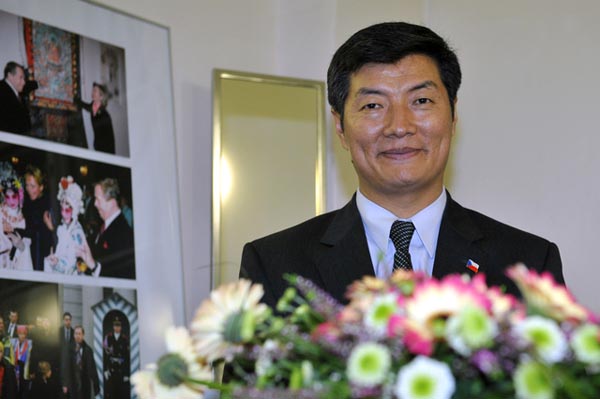
“China is formulating new security and economic policies and we have learnt that the new policies differ from those of the American National Security Council as the Chinese policies will have dual duties with responsibility over domestic security as well as foreign policy,” Prime Minister of the Tibetan government-in-exile Dr Lobsang Sangay said here on the sidelines of the Himalayan festival at the historic ridge.

He said the task force constituted by the Central Tibetan Administration to assist the dialogue with China would study the new economic and security policies of China.

He said dialogue was the only way to resolve the half-a-century-old Tibetan issue.
The Dalai Lama envoys have held nine rounds of talks with China and the last round of talks was held in 2010, since then there has been no dialogue between the two parties.

He said, “The Central Tibetan Administration is ready take the middle way on the Tibet issue and we are ready to engage in any meaningful dialogue with China anywhere and at any time.”

He said, “We have already presented a memorandum to Beijing, seeking autonomy for Tibet as enshrined in the constitution of China.”

Sangay regretted that 122 Tibetans had committed immolation for their cause and many of them had died. Sangay termed the immolation in China as unfortunate.

He said, “These incidents have reflected the determination of the people of Tibet against the repressive policies of China. Repressive policies and political pressure of China is forcing Tibetans outside or inside Tibet for immolation.”
Sangay also expressed concern over the “degradation” of environment in the China-controlled Tibetan Autonomous Region.
Sangay denied reports that the Dalai Lama had plans to shift his base from Dharamsala that has been his second home since he fled Tibet in 1959 after Chinese troops marched into Lhasa.

“We have monasteries in south India also and the Dalai Lama has to visit those areas,” he said.
Later, delivering a special lecture on “Democracy-in-Exile: the case of Tibet” at Himachal Pradesh University, Sangay urged the university fraternity to study the 1914 Shimla agreement signed between Tibet and British-ruled India in which the mention of McMahon line has been made.

In his candid speech, Sangay underlined the need for understanding the Tibetan struggle for total freedom and called upon the professors, research scholars and students, especially historians, to study the 1914 agreement as this envisages the importance of Tibet and its sovereign existence as a nation and having McMahon line as the international border.

“Tibet is very vital in terms of democracy which is like the Indian democratic set-up: parliament, judiciary, civil administration functioning in unison to deliver justice,” he said lauding the Tibetans for being law-abiding citizens throughout their lives.
Later, vice-chancellor ADN Bajpai welcomed Dr Sangay.

Friday, 22 November 2013

China summons Spanish ambassador over Tibet arrest warrants

MADRID (Reuters) - China's foreign ministry summoned Spain's ambassador on Thursday after a Spanish court ruled that several of its former leaders should be arrested over allegations they had committed genocide in Tibet, the Spanish foreign ministry confirmed on Friday.

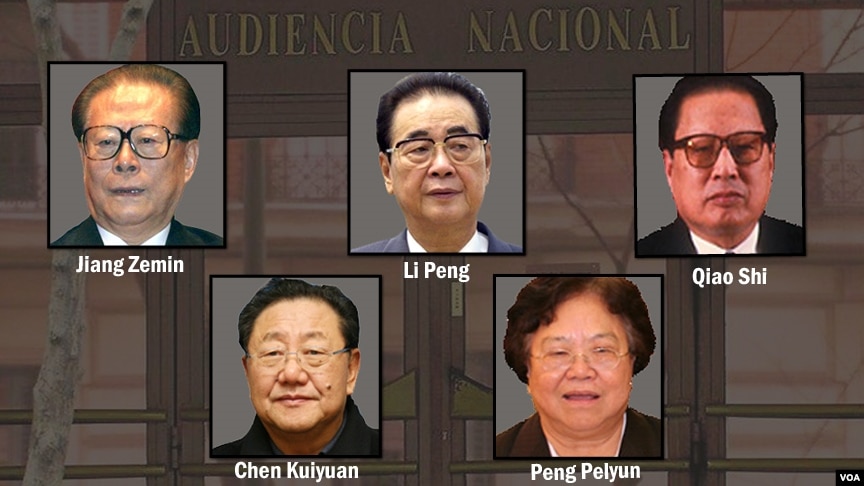
Former Chinese president Jiang Zemin and ex-prime minister Li Peng could face arrest when travelling abroad following a ruling from Spain's High Court on Tuesday.

Three other former high-ranking Chinese officials were also affected by the order, which triggered arrest warrants. They could be detained when they travel to Spain or other countries which recognize orders signed by Spain.

Beijing dismissed the case as absurd earlier this week and said it had sought clarification from Spain. The Chinese foreign ministry could not immediately be reached for comment on Friday.

"The case is being followed very carefully by Spain's foreign ministry and with some concern that these court actions could affect relations with China, which are very good," a Madrid diplomatic source said.

Beijing had transmitted its "deep unease" over the ruling in the meeting with the ambassador, the source added.

Discussions between senior Spanish foreign ministry officials and Chinese representatives have also taken place in Madrid.

Two Tibetan support groups and a monk with Spanish nationality brought the case against the former Chinese leaders in 2006 using Spanish law, which allows suspects to be tried for human rights abuses committed abroad when a Spanish victim is involved.

The Chinese officials are accused of human rights abuses in Tibet, which communist Chinese troops took control of in 1950. China says it "peacefully liberated" the Himalayan region it says was mired in poverty, exploitation and economic stagnation.

Last month, another ruling by the same Spanish court indicted former Chinese president Hu Jintao for alleged genocide in Tibet, a move denounced by China's government as interfering with its internal affairs.

The Tibetan spirit is becoming stronger and will long remain so: H.H. The Dalai Lama

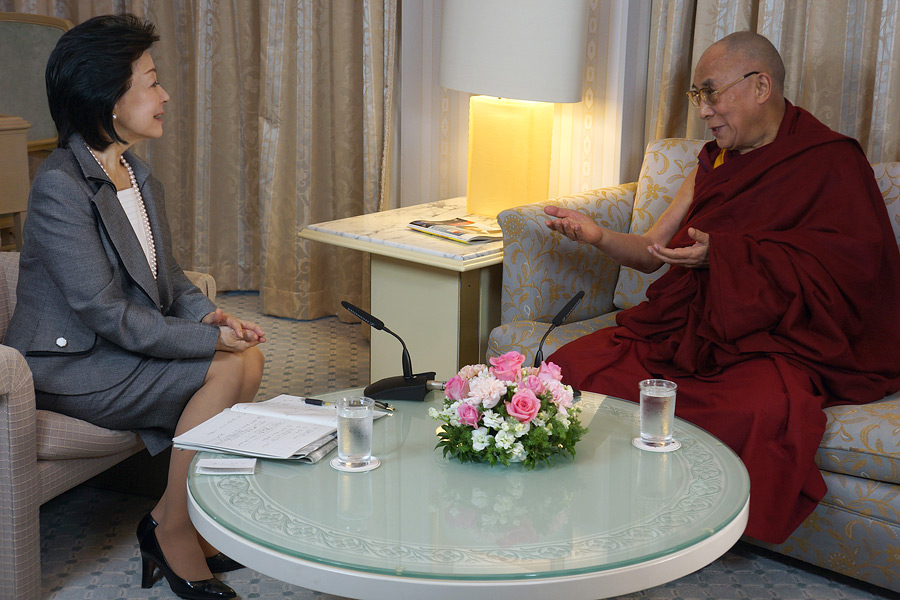
Ms Yoshiko Sakurai interviewing His Holiness the Dalai Lama in Tokyo, Japan on November 21, 2013. Photo/Jeremy Russell/OHHDL
"I am a promoter of democracy, which is why I have brought the role of the Dalai Lamas in Tibetan political affairs to an end. 

When the PLA reached Tibet, they came under to slogan of liberation. The party members I met in 1954 were committed to creating a new society, an equal, classless society. Their economic outlook was Marxist and focussed on equal distribution, which I found attractive then and still feel sympathetic to now. However, in about 1956 they began to introduce a more totalitarian system; they became isolated from reality, which would continue until Deng Xiaoping began to open China up and stress the need to seek truth from facts. Jiang Zemin emphasised development, while Hu Jintao stressed the need for harmony. But to achieve it he employed force and suppression, which was quite the wrong method. Harmony must come from trust, which is the basis of friendship. When you have suspicion and fear instead, there will be no harmony. I sometimes think these leaders need lessons in basic psychology. Their so-called liberation has brought only misery and mistrust.

The new leader seems to be more realistic in his approach. He seems to admire Hu Yaobang who visited Lhasa in the ‘80s, apologised for what had happened and promised to a reduction of the Han population. He was the Youth Leader when I was in Peking.

The Tibetan spirit is becoming stronger and will long remain so, even though the situation now is so harsh. Meanwhile, China will change. During the Cultural Revolution, drastic action was taken to eliminate ‘old ways of thinking’ which failed. Religion, for example, is related to emotions and human feelings. The Chinese Buddhist population, reliable sources tell us, is now 400 million, with many of them interested in Tibetan Buddhism. I think Buddhism will survive.

Brothers and sisters, we spend too much time dividing people into ‘us’ and ‘them’, thinking that overcoming ‘them’ will be a victory for ‘us’. These days we are too interdependent for this to be true. Whether I’m speaking to an individual or a public gathering like this, I never think of myself as a Buddhist, a Tibetan or even as the Dalai Lama, which would only tend to set me apart from others. As human beings we are all the same. We all want a happy life and have a right to lead it, which is why I try to promote the idea of the oneness of humanity."

The above is an extract from the interview answers of His Holiness the Dalai Lama in Tokyo Followed by Public Talk in Shizuoka

Wednesday, 20 November 2013

China dismisses as absurd Spanish arrest warrants over Tibet

China's former President Jiang Zemin looks up while President Hu Jintao gives his speech during the opening ceremony of 18th National Congress of the Communist Party of China at the Great Hall of the People in Beijing, November 8, 2012. REUTERS/Jason Lee/Files
(Reuters) - Former Chinese president Jiang Zemin and ex prime minister Li Peng could face arrest when travelling abroad over allegations they committed genocide in Tibet, a Spanish court ruled on Tuesday, in a case Beijing has dismissed as absurd.

Two Tibetan support groups and a monk with Spanish nationality brought the case against the former leaders in 2006 using Spanish law, which allows suspects to be tried for human rights abuses committed abroad when a Spanish victim is involved.

The two former leaders and three other high-ranking officials who worked in the government in the 1980s and 1990s, are accused of human rights abuses in the Himalayan region.

Although it is unlikely the leaders will end up in a Spanish dock, the case is reminiscent of the arrest of former Chilean dictator Augusto Pinochet in London in 1998 after a warrant was issued by former Spanish magistrate Baltasar Garzon.

Last month, another ruling by the same Spanish court indicted former Chinese president Hu Jintao for alleged genocide in Tibet. China's government denounced that move as interfering with its internal affairs.

China's foreign ministry spokesman, Hong Lei, said at a daily news briefing that Beijing has "sought clarification from Spain" about the latest ruling.

Tuesday's court order will now trigger arrest warrants which in turn could result in the suspects being arrested when they travel to Spain or other countries which recognise orders signed by Spain.

If the report is true, Hong said China expresses "strong dissatisfaction and resolute opposition" to the Tibetan support groups in Spain for "repeatedly manipulating the issue".

Zhu Weiqun, chairman of the ethnic and religious affairs committee of China's top advisory body to parliament, said the case was absurd, in comments published by Chinese state media on Tuesday before the ruling.

"If some country's court takes on this matter, it will bring itself enormous embarrassment," Zhu said. "Go ahead if you dare."

Communist Chinese troops took control of Tibet in 1950. China says it "peacefully liberated" the remote mountainous region that it says was mired in poverty, exploitation and economic stagnation.

Tibet's Buddhist leader, the Dalai Lama, fled to India in 1959 after an abortive uprising against Chinese rule. Exiled Tibetan groups are campaigning for the return of the Dalai Lama and self-rule for their region.

More than 120 Tibetans have set themselves alight in protest against Chinese rule since 2009, mainly in heavily ethnic Tibetan areas of Sichuan, Gansu and Qinghai provinces rather than in what China terms the Tibet Autonomous Region.

Most of those who set themselves on fire have died.

Tuesday, 19 November 2013

Spanish criminal court orders arrest warrants against Chinese leaders

Judges in the Spanish National Court today (November 18) ordered warrants of arrest to be issued against five Chinese leaders, including former President and Party Secretary Jiang Zemin, for their policies in Tibet. This ground-breaking development follows the news on October 9 of Hu Jintao’s indictment for genocide in Tibet. In a separate legal ruling also issued today in Madrid, the Spanish National Court also ordered that former leader Hu Jintao is informed of his indictment and sent questions about his policies in Tibet via the Chinese embassy.

The rulings today have positively surprised Spanish legal experts working on the Tibetan law suits upholding the principle of “universal jurisdiction” a part of international law that allows courts to reach beyond national borders in cases of torture, terror and other serious international crimes perpetrated by individuals, governments or military authorities. This new development was described to the International Campaign for Tibet by legal experts in Spain as being potentially as significant as the arrest of Pinochet in London in 1998 after a group of Spanish lawyers put together a lawsuit against the Chilean dictator, who presided over a 17-year reign of terror and ordered foreign assassinations.

The orders for arrest warrants are made against five senior Chinese leaders for their involvement in policies in Tibet as follows: Jiang Zemin, former President and Party Secretary; Li Peng, Prime Minister during the repression in Tibet in the late 1980s and early 1990s (and the crackdown in Tiananmen); Qiao Shi, former head of Chinese security and responsible for the People¹s Armed Police during the martial law period in Tibet in the late 1980s; Chen Kuiyuan, Party secretary in the Tibet Autonomous Region from 1992 to 2001 (who was known for his hardline position against Tibetan religion and culture), and Deng Delyun (also known as Peng Pelyun), minister of family planning in the 1990s.

The rulings, which go further than Spanish experts expected and send a strong signal to the Chinese leadership, mean that none of the leaders named, and others too, are likely to take the risk of travelling outside the PRC as they could be arrested for questioning on the crimes they are accused of. All the leaders face the possibility of bank accounts overseas being preventively frozen. In the earlier writ issued on October 9, the judges recognized that this indictment of Hu Jintao comes at the judicial moment “when his diplomatic immunity expires”.

Today’s ruling was made by the appeals court (Section 4 of the Criminal Court of Spain¹s National Court, the Audiencia Nacional), which is the investigative national court for major crimes such as terrorism, drug trafficking, piracy, or money laundering. It specifically refers to the “political and criminal responsibility” of the named Chinese leaders for their policies on Tibet and addresses the evidence presented to the court over the past eight years. This includes testimony from former political prisoners, international experts, documentation of killings and torture, and reports by ICT and other organisations. A report by the International Campaign for Tibet, ratified to the judge in Madrid in December 2012, outlined details of the chain of command for specific policies in Tibet from the imposition of martial law leading to torture and a climate of terror, to systematic patriotic education, compelling Tibetans to denounce their exiled leader the Dalai Lama. ICT described how the functions of the Communist Party override those of the Chinese state at all levels.

In making the ruling, the judges were acknowledging that there was ample and specific evidence to issue the order for arrest warrants. Orders of international arrest are carried out by police through Interpol or European Arrest Warrants in the EU and not by governments. The Chinese authorities responded to earlier writs with complaints to the Spanish Courts and government; Beijing has sought to quash the cases through direct intervention with the Spanish government and judiciary.

The Spanish lawyers acting for Spanish NGO Comite de Apoyo al Tibet (CAT) were requested by Court Room No 2 where the genocide lawsuit was lodged to provide a set of questions to former Party leader Hu Jintao about his policies in Tibet. The writ issued last month followed an appeal on July 29 following the judge¹s earlier rejection of a request to extend the lawsuit to include former Party Secretary and President Hu Jintao. The appeals court now accepts the argument put forward by the Spanish NGO Comite de Apoyo al Tibet (CAT) for Hu Jintao¹s indictment. This includes the period he was Party Secretary of the Tibet Autonomous Region in which he presided over the imposition of martial law in 1989, and also his responsibility for policy on Tibet as President and Party Secretary of China after 2003 “due to being the highest ranking person in both the Party and the Government”.

Friday, 15 November 2013

China unveils boldest reforms in decades

China's President Xi Jinping stands next to a Chinese national flag during a welcoming ceremony at the Great Hall of the People, in Beijing, November 13, 2013. REUTERS/Jason Lee
(Reuters) - China unwrapped its boldest set of economic and social reforms in nearly three decades on Friday, relaxing its one-child policy and further freeing up markets in order to put the world's second-largest economy on a more stable footing.

The sweeping changes helped dispel doubts about the leadership's zest for the reforms needed to give the economy fresh momentum as three decades of breakneck expansion shows signs of faltering.

A reform document released by the Communist Party following a four-day conclave of its top brass promised land and residence registration reforms needed to boost China's urban population and allow its transition to a western-style service and consumption-driven economy.

Pricing of fuels, electricity and other key resources - now a source of major distortions - would be mainly decided by markets, while Beijing also pledged to speed up the opening up of its capital account and further financial liberalisation.

"The reforms are unprecedented," said Xu Hongcai, senior economist at the China Centre for International Economic Exchanges, a well-connected Beijing think tank. "Reforms in 1990s were limited to some areas, now reforms are all-round."

President Xi Jinping and Premier Li Keqiang, appointed in March, announced several breakthroughs in social policy, pledging to unify rural and urban social security systems and to abolish controversial labour camps, the official Xinhua news agency reported, citing the document.

The plans, more comprehensive and specific than initially thought, also dispelled concerns that Xi would need more time to take full charge of China's vast party and government bureaucracy.

China-watchers took the establishment of a working group to lead economic reform and a new State Security Council as further signs of how effectively Xi managed to consolidate power just eight months after he officially took over.

"This is almost an unprecedented move toward unlimited power," said Zhang Lifan, a Beijing-based historian and political commentator.

The initial brief reform outline published on Tuesday triggered a stock market sell-off, with investors taking its scant details as a sign of a lack of commitment on Xi's part or his inability to convert vested interests, such as powerful state-owned companies.

But a raft of specific policy plans ranging from interest rate and currency regime liberalisation to residence registration and land reforms and the opening up of some of the protected sectors to private and foreign firms seemed to put such concerns to rest.

The commitment to abolish labour camps was also remarkable, given that several political sources had told Reuters this was an area where Xi was facing much resistance.

Few commentators had also expected any significant attempts to reform powerful state monopolies, even though many economists argue that other reforms will have only limited success if the big state-owned firms' stranglehold on key markets is not tackled.

The initial outline of the plans on Tuesday had affirmed those firms' strategic role in the economy. But the longer report on Friday raised state firm dividend payments, allowed private firms to enter some of the protected sectors and encouraged them to take part in reforming the state-owned firms.

What appeared to be an early leak of the document on Chinese social media set off a rally in Chinese stock markets hours before its official release, with investors cheering its relatively detailed language on reforms.

Still, economists said that having a good plan was only part of the success and making the ambitious agenda a reality would be the new leaders' true challenge.

"Based on the headlines ... they are moving in a positive direction," said Jan von Gerich, fixed income chief analyst with Nordea Bank in Helsinki. "But one should not get too carried away as this will be a long process."

Monday, 11 November 2013

Karmapa: Chinese activities in Tibet disastrous for whole Asia

Urgyen Trinley urged India to voice its concerns over Chinese development activities in his Himalayan home country.

"During the more than 50 years since China took over Tibet, there has been a great deal of development and activity including military installations by the Chinese that have impacted the Tibetan environment," Trinley told AFP.

"The fact China has control of Tibet does not mean they have the right to do whatever they want to the Tibetan environment," Trinley, who fled Tibet to India in 2000, said.

India, which fought a brief but bloody border war with its giant neighbour in 1962, accuses China of large scale construction of military infrastructure on its frontiers.

"A great deal of mining and dams are in Tibet now," the Buddhist monk, who resides in the northern state of Himachal Pradesh, said in an interview in New Delhi.

"Whatever happens to the Tibetan environment will definitely impact its neighbours and also eventually all of Asia," Trinley said through an interpreter.

"India has the deepest connect with Tibet and I would hope for a more clear expression of concern for the Tibetan environment from India," the spiritual leader added.

Trinley said he was in the national capital to educate "monks and nuns who live in monasteries in the Himalayan region" on environmental issues.

Tibetans have long chafed at China's rule over the vast Tibetan plateau, accusing Beijing of curbing religious freedoms and eroding their culture and language.

Trinley is recognised by both China and the Dalai Lama as the reincarnation of the Karmapa Lama, head of the Karma Kagyu lineage, one of Tibetan Buddhism's four major schools.

Tsering Gyal, 20, set himself ablaze in Tibet to protest against Chinese rule

tibet-Gyal-nov2013.gifA young Tibetan monk burned himself Monday in protest against Chinese rule in Tibetan-populated areas and demanding the return of Tibet's spiritual leader the Dalai Lama, sources said.

The protest came as Tibetans in several counties in Sichuan and Qinghai provinces refused Beijing's orders to fly China’s national flag from their homes amid a campaign of forced displays of loyalty to the Chinese state. 

Tsering Gyal, 20, set himself ablaze at 6:30 p.m. in Pema (in Chinese, Banma) county in Qinghai province's Golog (Guoluo) Tibetan Autonomous Prefecture, a source in Tibet said.

The condition of Gyal, from the Akyong monastery in Pema county, is not immediately known as Chinese police put out the fire and took him to a nearby hospital, the Tibetan source said

"He did it for the freedom of six million Tibetans and to highlight the need to re-install His Holiness the Dalai Lama to his golden throne," the source told RFA's Tibetan Service. "He called on the Tibetans to rise up now."

"Not long after he set his body on fire, police arrived and intervened. They put out the fire and rushed him to the local county hospital," the source said. 

"The hospital is surrounded by police who have imposed restrictions in the area."

The self-immolation came more than a month after a Tibetan father of two burned himself to death in Sichuan province to protest against Chinese policies in late September.

Shichung, 41, self-immolated near his house in Ngaba (in Chinese, Aba) county in the Ngaba Tibetan Autonomous Prefecture after lighting butter lamps in front of a portrait of the Dalai Lama.

Gyal's self-immolation brings to 123 the total number of Tibetans in China who have self-immolated calling for Tibetan freedom and for the return to Tibet of the Dalai Lama, who fled into exile in 1959 following a failed national uprising against Chinese rule. 

The self-immolation occurred after residents of Sichuan province’s Kardze (in Chinese, Ganzi) county in the Kardze Tibetan Autonomous Prefecture and in Dzatoe (Zaduo) county in Qinghai province ’s Yulshul (Yushu) Tibetan Autonomous Prefecture refused orders to fly China’s national flag from their homes last week.

Saturday, 9 November 2013

China forces Tibetans to fly Chinese flag on their house in Tibet!

Tibet-Chinese-flag-june2013.gifResidents of two more Tibetan-populated counties in Chinese provinces are refusing orders to fly China’s national flag from their homes, as authorities continue to press a campaign of forced displays of loyalty to the Chinese state, sources in the region say.

The latest acts of defiance were reported in Sichuan province’s Kardze (in Chinese, Ganzi) county in the Kardze Tibetan Autonomous Prefecture and in Dzatoe (Zaduo) county in Qinghai province ’s Yulshul (Yushu) Tibetan Autonomous Prefecture.

Previously, Tibetans in another county in Qinghai had refused the order to fly the flag, and residents of a county in the Tibet Autonomous Region (TAR) took flags distributed for display and dumped them in a river, prompting a security crackdown in which Chinese police fired into unarmed crowds.

This week in Kardze county, officials in Dongkhor township called meetings in area villages to urge local residents to fly the flag, a local resident told RFA’s Tibetan Service on Thursday.

“Beginning yesterday or the day before, government officials of Dongkhor township visited villages in Dongkhor and convened meetings in which they stressed the importance of flying Chinese flags from the roofs of people’s homes,” RFA’s source said, speaking on condition of anonymity.

“However, Tibetans attending the meetings strongly objected to the idea, arguing that Tibetan houses in the area had never flown Chinese flags in the past,” he said.

Officials countered by saying that people in other areas had already agreed to fly the flag, adding that compliance in those places had resulted in “generous government assistance.” 

And while villagers were free to express their views and concerns, “no one”—not even the officials themselves— could predict the consequences of continued refusal, they said.

'No one is flying the flags'

Meanwhile, in Dzatoe county, an area hit by protests against Chinese mining operations, officials have also issued orders to Tibetan homes and monasteries to fly the Chinese flag, a local source told RFA, also speaking on condition of anonymity.

“In the past, the Chinese authorities have only ordered Tibetans involved in protests against the government to fly the flags from their homes, but now the local people are worried that everyone may be forced to do so,” RFA’s source said.

The families of government employees and recipients of government assistance have been told to take the lead in flying the flags, he said.

“But so far, no one is flying the flags from their homes.”

Separately, a Tibetan living in India confirmed the order, citing local sources.

“So far, not a single house is flying the Chinese flag on their house,” he said.

On Oct. 15, residents of a Tibetan township in Qinghai’s Chentsa (Jianzha) county refused demands to hoist the Chinese flag, highlighting the growing resistance to forced displays of loyalty to the Chinese state and the ruling Chinese Communist Party.

The move followed weeks of protests in Driru (Biru) county in the TAR’s Nagchu (Naqu) prefecture earlier in the month in which Tibetan villagers refused to fly Chinese flags from their homes, throwing them instead into a river and prompting a deadly security crackdown.

Shootings in Driru’s Sengthang and Trinring villages on Oct. 8 left four dead and at least 50 injured, sources said.

Earlier, on Oct. 6, security forces shot and wounded at least 60 Driru-area Tibetans demanding the release of a villager who had led protests against Chinese orders to hoist the flags.

Sporadic demonstrations challenging Beijing’s rule have continued in Tibetan-populated areas of China since widespread protests swept the region in 2008.

A total of 122 Tibetans have also set themselves ablaze in self-immolation protests calling for Tibetan freedom , with another six setting fire to themselves in India and Nepal.

Thursday, 7 November 2013

China, the next Giant North Korea?

"President Xi Jinping vowed last month that country would break free of the "middle income trap", the fate of countless states in Latin America and around the world after their catch-up booms in the 1960s, all failing to make the switch in time to a grown-up growth model.

The reforms will, in theory, break China's destructive reliance on investment - a world record 49pc of GDP - and allow the hard-working Chinese people to enjoy a less miniscule sliver of what they produce. 

Yet at the same time Mr Xi is tightening the grip of the Party, reviving the Maoist "mass line" and rectification campaigns of the Cultural Revolution. 

Qian Gang from the Hong Kong's China Media Project says it is an assault on China's fragile rule of law, warning that Mr Xi is "playing with fire".

What we see is a crackdown on the internet, the media, academia and even science. Mr Xi has studied what happened to the Bolsheviks when Mikhail Gorbachev began to open up the Soviet system, and seems to have drawn a grim conclusion. While I don't attach much importance to the six bomb attacks on Party offices in Taiyuan on Wednesday, or the Uighur attack days earlier in Tiananmen Square, this will strengthen the hand of the hardliners. A few cycnics even claim that is the purpose of such terrorism.

China experts are deeply divided. Minxin Pei says the reforms are skin deep and that the door is fast closing on a benign outcome. The rising risk is that the Party will try to retain power by repression, ultimately turning China into a "giant North Korea".

A joint report last year by the World Bank and China's Development Research Centre - brain trust of premier Li - warned that failure to ditch the old model would leave China languishing in the middle income trap, failing to join Japan, Korea, Taiwan and a rare vanguard of countries that have made it into the elite league and achieved vastly higher incomes per capita.

The only way for China to break out of this impasse is with a blast of Sino-Thatcherism and a sledgehammer blow to the Party apparatus that lives off the deformed structure. That is not on offer at the Third Plenum. Xi Jinping wants affluent Leninism, on his own terms. No such thing exists."

Wednesday, 6 November 2013

Blasts kill one near Communist Party offices in China

(CNN) -- A series of explosions in front of Communist Party offices in a northern Chinese province killed one person and wounded eight others Wednesday morning, authorities said.

The blasts occurred in Taiyuan, the capital of Shanxi province, police said in a post on Weibo, a Twitter-like microblog platform.

State broadcaster CCTV reported on its Weibo account that several devices exploded in flower bushes in front of the gate of the Shanxi Provincial Communist Party offices. The Communist Party has ruled China for more than 60 years.

The blasts shattered the windows of nearby vehicles and shredded some of their tires, CCTV reported.

Footage from the scene showed cars with smashed windows and smoke rising in central Taiyuan.

State-run news agency Xinhua reported that steel beads were scattered at the scene, suggesting the explosive devices were homemade.

Police halted traffic for several hours on roads near the scene of the explosions.

At least one of the wounded people is severely hurt, CCTV said, adding that the exact number of casualties remained unclear.

Authorities are still investigating the cause of the blasts, which occurred days before a major Communist Party leadership meeting is set to start in Beijing this weekend.

Heightened security

Security concerns are already heightened in China following a deadly attack in Beijing's Tiananmen Square last week in which a vehicle drove into a crowd of people, crashed into a footbridge and burst into flames.

Chinese authorities have blamed Uyghurs from the western region of Xinjiang for that attack, which killed five people -- including the three in the vehicle -- and wounded 40 others in the heavily policed heart of the Chinese capital.

A top Chinese security official said last week that a murky Islamic separatist group had instigated the attack.

But there were no initial suggestions Wednesday that the blasts in Taiyuan were related to the Tiananmen attack.

Acts of violence, sometimes using rudimentary explosive devices or gasoline, take place from time to time in China. The culprits, according to authorities, are often local residents with personal grievances.

In May 2011, a series of explosions hit government facilities in the eastern Chinese city of Fuzhou. The blasts killed three people, including an unemployed local man who authorities said was suspected of setting off the bombs.

Earlier that month, a disgruntled former employee threw an ignited bottle of gasoline into a bank in a rural area of Gansu province. Authorities said the man had carried out the attack, which wounded 49 people, in retaliation for being fired.

In July 2010, a disgruntled businessman set off a homemade bomb at a local tax bureau in Hunan province in southern China, killing four people and wounding 20 others.

Tuesday, 5 November 2013

Excerpt: The Chinese are anxious over the future

By Fred Hiatt, BEIJING
"One result is that not only China’s billionaires but also, increasingly, the new middle class is hedging bets, thinking about obtaining foreign passports and moving money abroad. The mirthless joke is that President Xi Jinping’s inchoate slogan of “a Chinese dream” refers to getting your kids into an American university.

The challenges are well understood. People have to bribe their children’s teachers for a desk near the front of the class and bribe their bosses for a promotion. Political power has become a ticket to loot: The 50 wealthiest members of the U.S. Congress have assets of $1.6 billion, the Economist recently reported, while their 50 Chinese counterparts have amassed $95 billion.

The Communist Party pledges to weed out this corruption. But police and judges are subservient to the party, and so far the party dares not allow an independent rule of law.

Last Tuesday the sun, when visible, was an eerie orange disc behind the smog. People in Beijing and many other cities won’t let their children play outside for fear of the poisoned air, and they worry too about poisoned rivers and adulterated foods. Again, the party pledges reform. Again, it’s hard to know whether reform can succeed as long as well-connected polluters need not fear the law.

China needs to transition from a catch-up, copy-cat economy to one that innovates. But can you have unbridled innovation in a society where the media are controlled, books are censored, and bloggers, while much freer, are punished or silenced if they stray too far?

There is growing inequality. There is unfavorable demography: Thanks to longer lives and the enforced one-child policy, China will have fewer and fewer workers to support more retirees. There is tension with Tibetans and Uighurs, who want more autonomy.

China’s people, having had no say in Xi’s selection, will be watching, anxiously, to see what they have in mind."

Saturday, 2 November 2013

China hasn’t earned a spot on Human Rights Council

By Yang Jianli
While it is debatable whether the United States should intervene in criminal cases in China, such as that of the recently executed street vendor Xia Junfeng, it is unacceptable for Washington to ignore China’s human rights record when it can raise the issue without being accused of “interfering in internal affairs.” Washington will have such an opportunity when the U.N. General Assembly chooses new members of its Human Rights Council this month.

China, after a year of leave, is seeking a three-year term on the council. It is critical for the United States to show Beijing’s new leaders that their horrific treatment of citizens matters. U.S. government agencies, Congress, U.N. human rights monitors and human rights organizations show the atrocious extent of Chinese repression. Putting China on the U.N. Human Rights Council would be like picking the fox to guard the henhouse — while it was still wiping feathers off its mouth. Yet the Obama administration appears to approve of doing so.
For many reasons, China is unfit to sit on a council charged with protecting human rights: As the Congressional-Executive Commission noted in its 2012 annual report, forced abortions and sterilizations are still common in China. The State Department’s 2012 report on human rights said that the denial of religious freedom in China remains pervasive and was particularly severe against Tibetan Buddhists, Muslim Uighurs, Falun Gong practitioners and members of house churches.

China tortures its citizens. This is a violation of the Convention Against Torture, to which Beijing is a party. Beijing also returns refugees to North Korea, where they will be imprisoned and tortured. This is a violation of the Convention on the Status of Refugees, which China has signed.

Dungeons across China hold tens of thousands of Tibetans, Uighurs, Mongols,Christians, Muslims, Falun Gong and Han Chinese who bravely seek to defend the human rights of those persecuted for their faith or ethnicity or for seeking the rule of law. China is the only country in the world that detains a Nobel Peace Prize laureate.Tibetans are driven to self-immolation by their continued oppression. TheCongressional-Executive Commission on China annually details gross violations of human rights.

China’s brutal actions belie its claim that economic modernization would lead to decreased human rights abuses. Such notions are disproved by headlines about the latest outrages, such as when human rights lawyers were beaten earlier this year while seeking to visit unlawfully jailed political prisoners. China’s “reforms” involve change in economic and governmental institutions or minor procedural improvements. They do not extend to meaningful human rights reform.

President Xi Jinping’s “commitment” to the rule of law was exposed as a lie when one of China’s most prominent human rights advocates, Xu Zhiyong, was detained in July. The Post editorialized: “The detention of Mr. Xu suggests that the powerful machinery of the Chinese state security remains on the prowl against those who challenge the [Communist] party’s monopoly on power . . . a system in which the party-state stands above human rights, freedom and rule of law.”

Some believe that the United States cannot press China on human rights because it seeks Chinese cooperation on economic and national security issues. But Washington hasnegotiated arms-control and trade agreements with other countries, including the Soviet Union, while pressing for human rights reform.

Other nations have risked economic ties to criticize Beijing, including Norway, which awarded the Nobel Peace Prize to Liu Xiaobo over China’s strong objection; Canada, which has sharply criticized Chinese treatment of Tibetans; and the European Union, which has condemned China’s human rights abuses.

To be elected to the council, candidates must get 97 votes from General Assembly members. If each U.N. democracy votes no, China will not succeed. U.S. resolve would help other democracies summon the courage to confront China. The United States has opposed other candidates for the council that have terrible human rights records, including Syria and Iran. Beijing’s record of rights abuses is even worse.

How could U.S. representatives at the United Nations vote to place the torture capital of the world on the international body charged with protecting human rights? The United States may not have been able to intervene in the case of Xia Junfeng. But opposing China’s candidacy for the U.N. Human Rights Council is the least Washington can do.

Yang Jianli is founder and president of Initiatives for China. He was imprisoned in China from 2002 to 2007 for attempting to observe labor unrest.

China vows to silence Dalai Lama in Tibet

Beijing — China's ruling Communist Party aims to silence the voice of the Dalai Lama in his Tibetan homeland by tightening controls on media and the Internet, a top official said on Saturday.

The party's top-ranking official in the Tibet region Chen Quanguo vowed to "ensure that the voices of hostile forces and the Dalai group are not seen or heard," in an editorial published in a party journal called Qiushi.

Officials would "make sure that the voice of the party is heard and seen everywhere in this vast 120 million square kilometre region," Chen wrote in the editorial.

China has worked for decades to control the spread of information in Tibet, but some Tibetans remain able to access non-official sources of information including from exiles abroad by using radio, television and the Internet.

But the party will attempt to stamp out access to such sources by creating party cells in some websites, confiscating satellite dishes and registering telephone and Internet users by name, among a host of other measures mentioned in the the article.

China calls Tibetan exiled spiritual leader the Dalai Lama a "wolf in sheep's clothing" and accuses him of masterminding violent efforts to seek independence for Tibet.

The Dalai Lama, who fled to India in 1959 after a failed uprising against Chinese rule, says he advocates greater autonomy for Tibetans rather than independence.

Chen referred to Tibet as "a front line of the struggle against separatism" and vowed to "strengthen the role of party committees at every level, as the sole power", in the editorial.

Tensions between Tibetans and the Chinese government continue run high, with more than 120 members of the minority setting themselves on fire in protest in recent years, leading to a security crackdown.

Chinese police opened fire on Tibetans marking the Dalai Lama's 78th birthday in July, shooting at least one monk in the head and seriously wounding several other people, overseas rights groups said.

Wednesday, 30 October 2013

China suspects Tiananmen crash a suicide attack - sources

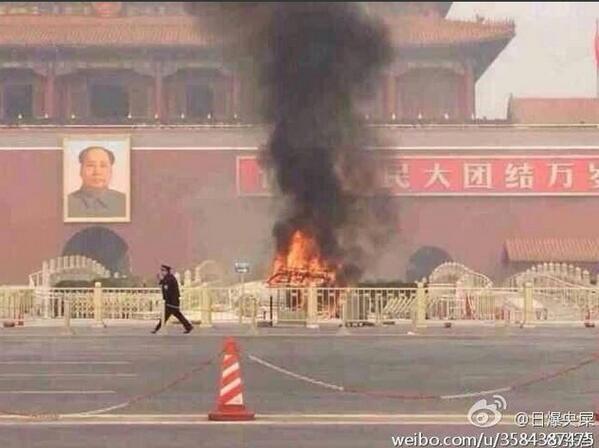
Vehicles travel along Chang'an Avenue as smoke raises in front of a portrait of late Chinese Chairman Mao Zedong at Tiananmen Square in Beijing October 28, 2013. REUTERS/Staff(Reuters) - Chinese authorities investigating what could be Beijing's first major suicide attack were searching for two men from Muslim-dominated Xinjiang on Tuesday after three people suspected to be from the restive region drove a SUV into a crowd at Tiananmen Square and set it on fire.

They killed themselves and two tourists on Monday in the square, the heart of China's power structure and the focal point of the mass 1989 pro-democracy demonstrations brutally crushed the military.

Police have spread a dragnet across the capital, checking hotels and vehicles, seeking two people suspected to be ethnic Uighurs, a Muslim minority from Xinjiang in China's far west, on the borders of ex-Soviet Central Asia.

Two senior sources said on Tuesday the crash, that also injured 38 bystanders at perhaps the most closely guarded location in China, was suspected of being a suicide attack carried out by people from Xinjiang. It was initially believed to be an accident.

The sources did not specifically say the occupants were Uighurs, many of whom chafe at Chinese controls on their culture and religion.

"It looks like a pre-meditated suicide attack," said a source with direct knowledge of the matter, speaking on condition of anonymity to avoid repercussions for talking to the foreign media.

There have been suicide bombings before in China, and in Beijing, mostly by people will personal grievances, but none have targetted the very heart of China's government like this appears to have.

China has blamed Uighur separatists and religious extremists for a series of attacks in Xinjiang, saying they want to establish an independent state called East Turkestan. Rights groups and exiles say China massively over-states the threat.

In 2009, nearly 200 people were killed in clashes between Uighurs and ethnic Chinese in Urumqi, the capital of Xinjiang.

But the unrest has never before spilled over into the nation's capital, despite speculation in 1997 that Uighurs were to blame for a Beijing bus bomb in which at least two people died.

Uighurs are also not known to have previously carried out any suicide attacks.

The government has given no official word whether it was an accident or an attack, and state media has mostly kept to reporting brief statements from the police and official Xinhua news agency giving a bare bones account of what happened, as is common for such sensitive events.

Police are still investigating and have yet to determine the identities of the three people in the sport utility vehicle but suspect they are from Xinjiang, according to the sources. The other dead were a Chinese man and a Filipina woman, both tourists.

"IT WAS NO ACCIDENT"

However, Beijing police said late on Monday they were looking for two suspects from Xinjiang in connection with a "major incident", though it was unclear if these were the people who were in the vehicle or accomplices still at large.

The sources said that the occupants were suspected of lighting a flammable substance in the vehicle.

"It was no accident. The jeep knocked down barricades and rammed into pedestrians. The three men had no plans to flee from the scene," said a source who has ties to the leadership.

A Reuters reporter at the scene at the time said he did not hear any gunshots.

On Monday night, hours after the fire, Beijing police issued a notice asking local hotels about suspicious guests who had checked in since Oct 1 and named two suspects it said were from Xinjiang. Four hotels told Reuters they had received the notice.

Judging by their names, the suspects appeared to be ethnic Uighurs.

"To prevent the suspected persons and vehicles from committing further crimes ... please notify law enforcement of any discovery of clues regarding these suspects and the vehicles," said the notice, which was widely circulated on Chinese microblogs.

Beijing police, contacted by telephone, declined to comment. On Monday, the police said on their official microblog only that they were investigating the accident, and did not say if they thought it was an attack.

Calls to the Xinjiang government went unanswered.

Barry Sautman, a political scientist at the Hong Kong University of Science and Technology who has studied Xinjiang, said if it was confirmed that it was a suicide attack by Uighurs, it would be a first.

"Certainly there have been a lot of bombings carried out by Uighur groups, but none of them as far as I know have involved suicide," he said.

Ilham Tohti, a China-based ethnic Uighur economist and longtime critic of Chinese policy in Xinjiang, said Uighurs had been driven to take extreme measures by China's repression.

"The use of violent means happens because all other outlets for expression are gone. Uighurs do not have any representation, they have no means of self-expression," he told Reuters.

IN FRONT OF MAO'S PORTRAIT

Police said on Monday the sport utility vehicle veered off the road at the north of the square, crossed the barriers and caught fire almost directly in front of the main entrance of the Forbidden City, in front of a huge portrait of the founder of Communist China, Mao Zedong.

Pictures seen by Reuters showed that the vehicle appeared to have driven several hundred metres (feet) along the pedestrian pavement in front of the Forbidden City entrance before bursting into flames, knocking down people as it went.

One eyewitness, who asked not to be identified due to the incident's sensitive nature, said she saw the vehicle knock down three or four people, and that it had a white banner with black lettering on it streaming from the back.

"People started to panic, and all ran to hide in the toilet," she said. "Three or four minutes later I came out and could see black smoke, and the police had begun to clear people out."

While censors moved quickly to remove pictures of the incident from the popular Twitter-like service Sina Weibo, as often happens in stability-obsessed China, many images and accounts are still viewable a day after the event.

Beijing police stepped up checks on cars around the city in response to the incident, one police officer at a checkpoint on the border between Beijing and Hebei province told Reuters.

A state newspaper reported in July that the government suspected Syrian opposition forces were training extremists from Xinjiang to carry out attacks in China.

"They have been known to carry out attacks outside of Xinjiang," said Yang Shu, a terrorism expert at China's Lanzhou University.

"There have also been reports that East Turkestan elements have received training in Syria, so I would say the possibility does exist of a Xinjiang connection," he added.

China denies mistreating any of its minority groups, saying they are guaranteed wide-ranging religious and cultural freedoms.

Many rights groups say China has long overplayed the threat posed to justify its tough controls in energy-rich Xinjiang, which lies strategically on the borders of Central Asia, India and Pakistan.

Chinese Officials Remove Tibetan Village Leaders Who Protested Against Crackdown

tibet-Dzato-down-aug2013.gifAuthorities in a Tibetan-populated county in northwestern China’s Qinghai province have dismissed three village leaders from their posts following area protests and ahead of plans to force villagers to fly the Chinese national flag from their homes, Tibetan sources say. 
The three had protested Chinese actions against Tibetans following clashes over mining operations in Dzatoe (in Chinese, Zaduo) county in August, a Tibetan living in exile told RFA’s Tibetan Service, citing contacts in the region. 

“On Oct. 16, the Chinese authorities convened a meeting in Dzatoe and announced certain decisions,” Konchog Dondrub, who lives in India, said. 

“One of those decisions was to relieve the village heads, who were previously appointed by the Chinese with the approval of the local Tibetan community, of their responsibilities,” Dondrub said. 

Citing information received from local sources, Dondrub identified the village leaders removed from their jobs as Khetsa Soetob of Atoe Yultso, Ashak Gyaltsen of Dzachen Yultso, and Tronbu Utsa of Serza Yultso. 

The men had “complained against the government” following a security crackdown in August that left dozens injured and saw several detained, he said. 

“Restrictions on local Tibetans, both in the villages and the monasteries, have continued for the past two months,” Dondrub said, adding, “Chinese security officials are interrogating area residents and subjecting them to all kinds of pain and harassment.” 

Authorities are paying particular attention to how Tibetans in the area communicate with each other, he said.

Mining blocked

On Aug. 15-16, hundreds of Tibetan villagers blocked work at three mining sites—Atoe, Dzachen, and Chidza—in Dzatoe county, sparking a crackdown by at least 500 armed police, according to area sources.

Mining operations in Tibetan regions have led to frequent standoffs with Tibetans who accuse Chinese firms of polluting the environment and disrupting sites of spiritual significance.

Tibetan residents of Dzatoe have long regarded the mountains in their area targeted for mining as the abodes of protective deities, and documents appearing to give central government approval for the work were later found to be fakes, one source said.

"So this year, the Tibetans were determined to resist the mines," he said.

Tibetan government employees in Dzatoe are now protesting the Chinese officials’ decision to remove the village chiefs, Dondrub said. 

“They say they are unable to work with the Chinese officials who have tortured Tibetans, and demand that the men who were dismissed be allowed to return to work. They have presented a written appeal to Dzatoe county authorities to restore the village leaders to their original positions.” 

Now, authorities plan to order local Tibetans to fly the Chinese national flag from the roofs of family homes and monasteries in a forced display of loyalty to the Chinese state, Dondrub said. 

Authorities have enforced similar flag-raising campaigns in other Tibetan-populated areas of China in recent months, prompting clashes in which Chinese security forces have beaten and detained protesters and fired into unarmed crowds.

Monday, 28 October 2013

Fire at Tiananmen Square in China; Possible Self Immolation, 3 Dead

Embedded image permalink
A fire broke out on Tiananmen Square on Monday, prompting an evacuation and closure of the tourist attraction–and Chinese people are saying that it was a “self-immolation incident.”

The sensitive area is often under heavy guard.

Chinese police closed the road that runs through the square, a witness told Reuters.

Representatives of the Beijing government and police said they didn’t know what happened. Xinhua, a state-run media outlet, said via Twitter that a motor vehicle “went into the crowd.” It later reported that three people died, and multiple tourists and police officers were injured.

Reports on Weibo, a Chinese Twitter-like social media service, indicated that people believe that there was a self-immolation (that someone or more than one person set themselves on fire). Many of the photos posted online are being deleted, as is often the case in the heavily censored country, but many were preserved on Twitter.

“Craziest thing ever. Just walked inside TianAnMen square and a car explodes outside the square,” said Grace Ng, who is based in New York but is currently in Beijing, via Twitter. 

Philip Wen, a China correspondent for the Sydney Morning Herald, posted a photo showing police officers cleaning up after the fire.

Story developing; check back for updates

Saturday, 26 October 2013

Tibetan monks describe a web of unseen controls

By Dan Levin
New York Times

XIAHE, China » Buddhist monks in flowing burgundy robes hurried along the dirt paths of the Labrang Monastery, trying their best to ignore the scrum of Chinese tourists following their every move, many with cameras fit for paparazzi.
Pilgrims and those less spiritually inclined wandered through the ornate complex here in the mountain town of Xiahe to gaze upon towering Buddha statues bathed in incense. Some tourists held back to indulge in distinctly unenlightened pursuits, smoking cigarettes and pouting at their smartphones in the high-tech vanity ritual known as the selfie.

One of the most important sites in Tibetan Buddhism, Labrang presents an idyllic picture of sacred devotion that is carefully curated by the Chinese government, which hopes to convince visitors that Tibetan religion and culture are swaddled in the Communist Party's benevolent embrace.

But behind closed doors, many of the monastery's resident monks complain about intrusive government policies, invisible to tourists, that they say are strangling their culture and identity.

"Even if we're just praying, the government treats us as criminals," said a young monk, who like others interviewed recently spoke on the condition of anonymity to avoid government repercussions.

Such frustrations, many monks say, are what have driven more than 120 Tibetans to set fire to themselves since 2009, including 13 in the Labrang area, in a wave of protests that has gone largely unreported in the Chinese news media.

International human rights advocates say that rather than address the underlying grievances — including Beijing's deeply unpopular campaign to demonize the Dalai Lama, the exiled Tibetan spiritual leader — Chinese authorities have responded with even harsher policies that punish the relatives of those who self-immolate and imprison those who disseminate news of the protests to the outside world.

Exile groups and analysts say Labrang and a handful of other monasteries across the vast Tibetan plateau in Central Asia have become showcases for Beijing's strategy, which seeks to stifle dissent in well-trafficked tourist sites without scaring away visitors.

Monks here describe a largely unseen web of controls that keep potential troublemakers in line: ubiquitous surveillance cameras, paid informers and plainclothes security agents who mingle among the busloads of tourists. Hidden from the throngs are the political education sessions during which monks are forced to denounce the Dalai Lama. Stiff jail sentences await those who step out of line. "If we don't obey, it will be terrible for us," the monk said.

Founded in the early 18th century, Labrang Monastery is tucked into the dusky hills of northwestern Gansu province. Each day, hundreds of Chinese tourists arrive to spin colorful prayer wheels lining the monastery perimeter and sip tea at hotels designed to resemble Tibetan nomadic tents. Along the town's main street, they buy turquoise-encrusted amulets, dress up in monks' robes and take turns trying on the ceremonial yellow hats that resemble mohawk-style haircuts. Officials hope that a recently completed airport will draw even bigger crowds.

In a monastery courtyard surrounded by whitewashed mud walls, a Chinese family from the provincial capital, Lanzhou, knelt down to pray to Buddha. "If you ask nicely, he'll make your wish come true," said the mother, Ming Yang, who acknowledged that her understanding of Buddhism ended there.

With an eye on the lucrative prestige of a UNESCO World Heritage listing, the central government is giving the monastery a $26 million face-lift. Around 1,000 monks and 65,000 volumes of Buddhist scripture are housed in the sprawling complex, which local officials say is in dire need of structural improvements.

Yet locals complain that much of the construction is aimed at increasing tourism, rather than benefiting Tibetans. "It looks fancy, but in reality all the improvements are for Chinese people," one said.

Tourism is rapidly reshaping much of the Tibetan plateau. According to the Xinhua state news agency, 6 million tourists visited Lhasa, the capital of the Tibetan Autonomous Region, in the first eight months of this year, a 20 percent increase over the same period in 2012. The boom has attracted several international hotel chains to the city, which is under de facto martial law.

In May, Tibetan exile groups started a boycott campaign against the InterContinental Hotels Group, which is building a 2,000-room luxury resort next to the historic residence once occupied by the Dalai Lama.

In the wake of violent anti-Chinese protests that swept Tibet in 2008 and the wave of self-immolations that followed, security forces have tightened their grip. The crackdown reaches deep into the folds of Tibetan spirituality. According to the International Campaign for Tibet, officials have posted notices in Tibetan areas declaring it illegal to pray for self-immolators or to show solidarity "by burning incense, chanting religious scriptures, releasing animals from killing and lighting candles." At least two monks have been jailed for praying on behalf of self-immolators, the group said.

Exile groups say such tactics only alienate Tibetans further. "Even lighting a butter lamp or incense stick becomes an act against the state," Kate Saunders, communications director for the organization, said from London.

Yet local enforcement has been erratic. Nowhere is this more clear than at Labrang, where a framed photo of the Dalai Lama sits on an altar beside a large golden Buddha. For years, the government has banned photos of the Dalai Lama and forbidden Tibetans to worship him as a religious figure. Monks at Labrang said they believed local officials had decided to quietly tolerate such photos in an effort to head off further unrest.

On the tour, few of the Chinese day-trippers seemed to recognize the older, bespectacled man Beijing has called "a wolf in sheep's clothing." The monk guiding the group made no mention of his identity, lest it threaten the ticket sales and donations needed to cover operating costs.

But being the main attraction on a Buddhist safari has spiritual drawbacks.

"Chinese tourists just barge in when we're studying," a middle-aged monk said as he fingered a set of prayer beads. "It knocks on our minds, but they don't care."

Such complaints appear to be falling on deaf ears. During a tour of the region in July, China's top official in charge of ethnic minorities, Yu Zhengsheng, insisted that economic development was the panacea for what ailed Tibetans. In the same breath, he condemned the Dalai Lama's "middle way," which calls for genuine autonomy in Tibet but not independence, saying it conflicts with China's political system.

"Only when people's lives have been improved can they be better united with the Chinese Communist Party and become a reliable basis for maintaining stability," he said, according to Xinhua.

But local Tibetans seethe at China's refusal to recognize their most basic aspirations. "Our hope is that the Dalai Lama can return," said a monk, looking out for eavesdroppers while sitting at a cafe. "Without him, there is no chance our religion and culture will survive."

It costs a Tibetan his life to ensure two columns in a newspaper: Tenzin Tsundue

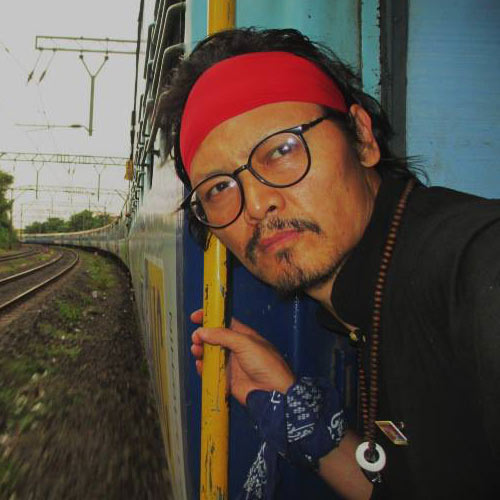
Tenzin Tsundue
"Tibetan struggle was primarily led by political activism on the streets to demonstrate our dissent. The biggest change in the last 10-15 years is that a deep sense of intellectual inquiry has crept in among the Tibetan youth. I think this is a huge leap. When a lot of people put in a lot of effort, it strengthens and sustains the community. It helps us define the freedom we are fighting for. The crux of the intellectual inquiry now is, ‘Are we demanding equal share of China’s mining in Tibet? Or China’s development in Tibet?’ Earlier, we would just deflect our protests to the Western media. Our demands and activism are changing now. A film festival like this tells our young people what the world is up to. And this, in turn, helps us in telling our own stories. A number of young people are using creative arts to exhibit their works.
I am deeply frustrated and angry that the international media has enough resources to report on the choice of clothes of celebrities, but is unable to and unwilling to investigate the causes of these self-immolations. It costs a Tibetan his life to ensure two columns or a picture in a newspaper. Much of the media is either state owned or corporate owned, with many having direct interests in China. This makes them naturally biased. The real reason behind these immolations is the brutal Chinese oppression of the Tibetan people, and the rejection of the Dalai Lama’s return to Tibet. Even after 121 cases of immolation so far, China continues to say that this was at the instigation of exiled Tibetans. At the ground level though, we will do anything to stop a self-immolation. When a Tibetan tried to immolate himself in Dharamshala in March this year, our activists stopped him from doing so and counselled him later."

Friday, 25 October 2013

China on the defensive as 11 countries challenge its policies in Tibet

Eleven countries spoe up to urge China to improve the human rights of Tibetans at the UN Human Rights Council in Geneva on October 22. The delegates cited the lack of religious freedom, minority rights, and access of UN officials to Tibet, and called on China to resume dialogue with the Dalai Lama, during oral questioning at the second Universal Periodic Review (UPR) of China’s human rights record.

The questioning represented a broadening and deepening of concern for Tibet from China’s previous UPR in 2009, when four countries specifically mentioned Tibet at the Council session. More than 130 countries spoke up on China’s rights record, with many critical, and some, such as Zimbabwe, Venezuela and Russia, supportive. Each country was given only about 50 seconds to make a statement.

At the end of the session, China dismissed the concerns of countries that highlighted concerns about its human rights record (see below). Its full reply to oral and written questions will be reported on October 25.

Canada (00.55.06): “Stop the prosecution and persecution of people for the practice of their religion or belief, including … Tibetans … and set a date for the visit of the Special Rapporteur on Freedom of Religion and Belief.”

Czech Republic (01.06.43): “Protect ethnic and religious minorities including Tibetans and Uyghurs and stop all disproportionate policies against them while addressing their discontent in a non violent dialogical manner.”

France (01.18.17): “Given the concerns aroused by the human rights situation of … Tibet to follow up to the recommendations of the Special Rapporteur on Freedom of Religion and Belief to go to this region.”

Germany (01.20.19): “To ensure democratic participation of members of all ethnic minorities, and allow unhindered access to all minority areas including Tibet.”

Japan (01.55.04): “Human rights and the fundamental freedoms must be ensured for minority groups such as Tibetans and Uyghurs. Japan recommends that further efforts be made to securing all human rights, including cultural rights for minorities.”

New Zealand (02.20.47): “As a consistent supporter of dialogue to achieve meaningful outcomes that address the interests of all communities in Tibet, New Zealand recommends China resume the two way dialogue in Tibet”

Poland (02.27.44): “Poland notes the joint communications of eight Special Procedures with regards to alleged systematic attempts to undermine the rights to freedom of religion, culture and expression of the Tibetan Buddhist community. Poland recommends that China takes the necessary measures to ensure that the rights of religion, culture and expression are fully observed and protected in every administrative entity of China.”

Switzerland (03.15.13): “Switzerland takes note of the candidacy of China for the council. In this context Switzerland recommends that they facilitate visits of OHCHR and Special Procedures including to Tibetan and Uyghur areas”

United Kingdom (03.27.45): “We also remain concerned about the human rights situation in ethnic minority areas including … Tibet in particular with respect to the protection of cultural rights and religious freedoms.”

United States (03.30.00): “Protect the rights of ethnic minority groups including Tibetans, Uyghurs and Mongolians, in accordance with the Chinese constitution and international human rights commitments.”

Iceland (03.35.16): “Facilitate the access of Special Rapporteurs on various human rights issues in Tibetan areas.”

In China’s final reply (03.36.40), its delegate said that, “Some countries in their comments equated security actions to protect civilians as ethnic cleaning, and called certain criminals in China as human rights defenders. Normal judicial procedures were called political persecution. This is a typical case of politicizing human rights… The best persons to know human rights in China are Chinese.”