search

Saturday, 1 December 2012

Dr. Lobsang Sangay: Tibet is not a priority for China


Speaking about the new policy of Tibet:
In China don't expect any change even with a new leadership. It is true Xi Jinping's father knew the Dalai Lama and even the Panchen Lama. He had in fact backed China's most liberal premier Hu Yaobang. Whether the father's ideas have influenced the son is not clear. We may or hope to see some change only after the 19th party congress in about five years from now. The present people are in their 60s, people whose minds were shaped in a different era. Also, the system carries on no matter whose in charge. Point to note is that Tibet is not a priority for China's government. How else can you explain Tibet and Tibetans being fed the same medicine even though it's apparent that the medicine is not working.
The recent chain of Self immolation:
Self immolation have now touched 85. There was one immolation in 2009 but in 2011 it shot up to 23. Match this with the crackdown on Tibetans seeking to enter India through Nepal. The Chinese have sealed close to 75 per cent of the border with Nepal. They have also trained Nepali border guards and are providing food and fuel to Nepali villages near the border to report the presence of any Tibetans in their area. Up to 2008, between 3000-5000 Tibetans used to enter Nepal, now it is down to 1000.
The positive here is that the international community is becoming increasingly vocal about Tibet. After a long time the UN High Commissioner for Human Rights Navi Pillay issued a strong statement on Tibet.
The Communist PLA government view on Tibet:
There is a theory (and this is only a theory) that the PLA leadership sees no purpose in their presence in every nook and corner of Tibet. Currently, PLA troops are deployed in villages, in small towns. This is apparently not liked by the top commanders who say their job is to defend the borders from invasion, not point their guns at their own people. Autonomy for Tibet is something they would be open to if it would lessen the tension and violence. China's defence budget is around $107 bn but the internal security budget is $111 bn and per capita the largest chunk of this budget is spent on Tibet's six million people.
There's another theory that the Chinese only trust their ethnic kin. They've granted autonomy to fellow Chinese in Hong Kong and Macao. The dialogue with Taiwan centres on the same readiness to extend autonomy to Taiwanese. This may not extend to Tibetans whom the Chinese clearly do not trust.
About the India-China relationship:
I think the Indian government is getting more realistic about China. I don't want to see any confrontation between India and China but Tibet is a standing example of what the Chinese are capable of. India needs to be more assertive vis a vis China. It's an example that will go down well with the rest of Asia.
adapted from the excerpt from the interview of Lobsang Sangay by IBNlive INDIA

Wednesday, 28 November 2012

His Holiness the Dalai Lama in Bangalore day 1:

On 26th of November afternoon, His Holiness the Dalai lama visited the Christ University Bangalore and spoke to the members of the Christ family. Here is the summary of His Holiness's speech:
"My dear elder brothers and sisters and younger brothers and sisters, treat me as a fellow human being for mentally, physically and emotionally we are all same people.Christians have made the greatest contribution to education. But they also indulge in conversions, sometimes causing problems. It is much better if we kept our own religious faith. Else, it will lead to confusions.

The Tibetan leaders have contributed much in the field of education. There are instances of certain institutions like the Ramakrishna Mission which have directly contributed to society.
Excepting for this, most religious leaders of these communities keep themselves isolated – they are either seen meditating or even half asleep. 
The 20th Century made a lot of advancements in science and technology, but it was marked by a lot of bloodshed. Around 200 million people were killed through violence and civil war during the century. The 21st Century has also faced violence in pockets, especially through terrorism. However, people belonging to the ages 30 years and below, who truly belong to the 21st Century, can change the future world - make it a better and peaceful place to live in. The younger generation must think more at a deeper level.
Think towards bridging the gap between the rich and poor, end corruption and crime. Science has now confirmed that a compassionate heart is the key to the good health of an individual as well as society. This is why I believe that religious faith and reason must go together"

The Tibetan Self Immolations

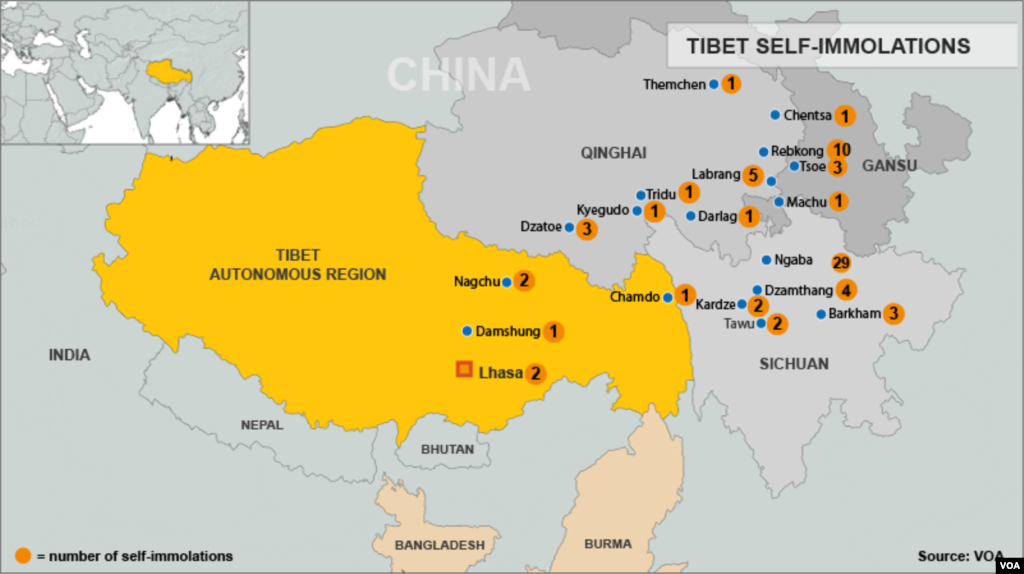
Tibetan Self-Immolations through November 26, 2012.
Since 2009, at least 85 Tibetans have set themselves ablaze to protest what they say is Beijing's repression of their culture and religion.  Nearly a third (23) of those self-immolations occurred in the past month, as China prepared for its 10-yearly power handover.
Talking about the second phase of self immolation in Tibet: "But now in this phase we have laypeople staging these immolations in ways that are much more determined in an attempt to get a response from Chinese authorities, by having immolations in clusters, very close together, many on the same day or within a few days and many in the same place" 
-Robert Barnett of New York's Columbia University
"We've got the provinces that sort of surround the Tibetan autonomous region all having self-immolations in the last couple months, as well as the diversity of the people involved, in terms of age ranges, in terms of occupations.  Both laypeople and monks and nuns [are] involved in these self-immolations.  Without a doubt, it's really reaching a crisis point,"
-James Leibold, a Tibet analyst for Australia's Latrobe University in Beijing
He also talks about Xi Jinping : "Sadly, we hear the same rhetoric coming out of Beijing, and Chinese officials continually blaming a few black hands for collaborating with the Dalai Lama and the exiled Tibetan community to stir up trouble and to damage China's ethnic unity and harmony.  There's just absolutely no will, it seems, to admit a failure of policy"

adapted from VOA

Wednesday, 21 November 2012

Situation of Tibetans inside Tibet


The Central Tibetan Administration solemnly maintains that the Chinese government’s treatment of Tibetans in Tibet is in breach of the rights to life, liberty and security and the freedom of expression, religion, culture and education. Today, in Tibet:
  • Any expression of opinion contrary to Chinese Communist Party ideology can result in arrest;
  • The Chinese government has systematically covered religious institutions in an attempt to eradicate allegiance to His Holiness the Dalai Lama, Tibetan nationalism and any dissention;
  • Tibetans are subject to arbitrary arrest and detention;
  • Those imprisoned are often denied legal representation and Chinese legal proceedings fail to meet international standards;
  • Torture still prevails in Chinese prisons and detention centres despite it being in contravention of the United Nations Convention Against Torture;
  • Due to subsistence difficulties, inadequate facilities and discriminatory measures, many Tibetan children are denied access to adequate healthcare and schooling;
  • The rate of imprisonment for political reasons is far greater than in other areas under Chinese rule;
  • Children are not exempt from China’s repression of freedom of expression. There are Tibetan political prisoners below the age of 18, and child monks and nuns are consistently dismissed from their religious institutions.
  • Enforced disappearances, where a person is taken into custody and the details of his detention are not disclosed, continue to occur;
  • Gedhun Choekyi Nyima, recognised by His Holiness the Dalai Lama as the 11th Panchen Lama, has been missing since 1995;
  • More than 70 percent of Tibetans in Tibet now live below the poverty line;
  • Thousands of Tibetans continue to flee their homeland in pursuit of freedom, livelihood, and education in the exile community, where the Indian government gives facilities that the Chinese government cannot even think of, much less provide.
Continual international pressure is essential in encouraging the Chinese government to abide by the regulations of the covenants of human rights.

extracted from CTA website

"Statement of Sikyong Lobsang Sangay on Allegations Related to Radio Free Asia"


 "Dharamsala, INDIA – It is unfortunate that the Central Tibetan Administration (CTA) and my name have been dragged into internal matters related to the Tibetan Service of Radio Free Asia (RFA). I want to categorically state that I have never approached either RFA President Ms. Libby Liu or members of the Broadcasting Board of Governors on matters related to RFA personnel.  I, therefore, have nothing to do with developments between RFA management and Mr. Jigme Ngapo.  Allegations of interference on personnel matter are completely baseless.
CTA takes great pride in maintaining fiscal integrity and transparency. Every dollar we receive in humanitarian and development assistance is accounted for, and, as required, funders receive clear, complete and timely statements on use of their funds.
RFA Tibetan Service was established to provide truthful and objective service to Tibetans particularly to listeners in Tibet deprived of unbiased and timely news and information. I want to thank the U.S. Congress and Government for establishing and funding this important program."
shared from CTA website

Tuesday, 20 November 2012

Why Was Ngapo Jigme, Director of RFA’s Tibetan Service, Suddenly Dismissed? - By Woeser

By Tsering Woeser
Originally published in High Peaks Pure Earth, November 13, 2012

I was deeply taken by surprise and was shocked to learn that Mr. Ngapo Jigme, the director of Radio Free Asia’s Tibetan service was suddenly dismissed on November 1. As far as I know, Tibetan intellectuals, media professionals, Chinese intellectuals studying the Tibet issue and international Tibet Studies experts, who live abroad, have all expressed that they did not understand what happened and were very surprised.

In 1985 Mr. Ngapo Jigme left Tibet, and worked for His Holiness Dalai Lama and the International Campaign for Tibet. He also studied at the Department of Government and Foreign Affairs at University of Virginia. He is well versed in all three languages of Tibetan, Chinese and English, and he possesses the outstanding spirit of an independent intellectual. Since 1996 when the U.S. Congress approved to establish the Tibetan service of Radio Free Asia, he had become absolutely the right person for the job and shouldered the important task as the founder. At present, under the 16 year devoted leadership of Mr. Ngapo Jigme, the Tibetan service of RFA, with over 30 journalists and editors, has become an important Tibet-related media, which can be called a shining example in the world. But he was suddenly dismissed without any reasons being given.

I have heard when the person in charge announced the dismissal of Mr. Ngapo Jigme in the presence of the staff of the Tibetan service, he refused to give any reasons for the dismissal. Meanwhile, the security personnel of RFA were ordered to escort Mr. Ngapo Jigme out of the building, and the action itself is tantamount to banishing him from the building. Nobody can understand why Mr. Ngapo, who is upright and has been dedicated to his work, is treated with such humiliation after having worked conscientiously for the media and journalism for 16 years.

I once worked for the media within the system under Chinese Communist Party control, and I knew well the ways how autocratic power works. But it has never occurred to me that, in a democratic society, dismissing one from his post can be done in such an autocratic way as well. The reasons for for the dismissal were neither explained, nor was the character and dignity of the person concerned taken into account.

By the way, I was also dismissed. By coincidence, it also happened after I had worked for 16 years. But at the moment, should I take the opportunity to praise the way in which the Chinese Communist Party authorities dismissed me? It happened in the office of the Party Secretary of TAR Federation of Literary and Art Circles. Smiling, one Tibetan and one Han Chinese official said to me gently, “because of your attitude toward your work, we’ve decided to allow you to resign voluntarily.” At that time I refused to resign on my own initiative, and answered, “I won’t resign on my own initiative, it’s fine for you to dismiss me.” This was handled not so badly as they did not order the security guards of the work unit to escort me out of the building, while leading a big black dog on a leash.

Judging by this −−− viewed from the fact that the person in charge did not give the reasons for the dismissal of Mr. Ngapo, comparatively speaking, the officials of CCP are more frank and honest. On one occasion 8 years ago, they clearly told me that the reason for them to deprive me of my position as the Editor for the journal Tibetan Literature was because I wrote a book and committed “very grave political mistakes.” At the time, the Deputy Director of the General Administration of Press and Publications gave the following explanation: “[The book] takes such serious political standpoints as praising the 14th Dalai Lama and the 17th Karmapa, and believing in and propagating religion, and the viewpoints [expressed in it] are erroneous. Some compositions, in a certain degree, have already entered into a certain political mistakes…” See, the CCP officials even made their reasons for dismissing me public.

As a listener of the Tibetan service of RFA for many years and also as a columnist who has written for RFA for the past six years, I know well how valuable the free and open platform for speech provided by the Tibetan service of RFA is. While it reports the news about the situation in Tibetan areas in China and Tibetan communities abroad in a timely fashion and truthfully, it upholds the values of an independent, balanced and pluralistic media, and adheres to the principle of freedom of speech and the impartiality of news. It also presents various voices so as to enable a variety of views to be expressed.The reason why the Tibetan service of

RFA has had great influence in Tibetan areas in China is precisely the result of the principle upheld by Mr. Ngapo over the past 16 years. I don’t know whether this is exactly the reason why he was dismissed, and one can only speculate about this. Because if it is the case, then this should be considered as dubious and a disgrace in a democratic society.

His Holiness Dalai Lama has repeatedly emphasized the importance of the truth, and the basis of truth relies on precisely the freedom of journalism. Just as His Holiness stated, “Unfortunately, in certain places in the world, news reports are generally censored and distorted,” and “vigorous censoring of news is immoral.” The autocratic regimes attempting to monopolize truth have always tried every means to control information and to hide the truth. The media under CCP control has always had only one voice, and the media serves as the mouthpiece and propaganda tools for the party. Thus, free media abroad is the irreplaceable channel for Tibetans inside Tibet to gain access to information and truth. In the struggle against autocracy, what we need to guard against the most is exactly using autocratic means to combat autocracy. If anybody wants to change the open and pluralistic Tibetan service of RFA into a propaganda tool and mouthpiece, then, the service will not only lose its current influence, but also seriously undermine the image of His Holiness Dalai Lama and obstruct the democratic process in Tibetan exile communities.

Thus, Radio Free Asia should clearly explain their reasons for dismissing Mr. Ngapo. This is not a personal issue for Mr. Ngapo alone, in reality, this has caused people from all circles to worry about the future of the Tibetan service of RFA. One will also be concerned with the negative impact it has for campaigns for Tibet abroad and the perplexity it has caused for people in Tibetan areas in China, in particular, at the juncture when the current situation in Tibet has never been so severe.

Finally, I would like to express my greatest admiration for and pay my respects to Mr. Ngapo −−− thank you for leading the Tibetan service of RFA for the past 16 years. While the service has provided truthful news for Tibetan listeners and has reported the serious situation in Tibet to the outside world, it has also shown the value of the principle of impartiality of news, balanced news reporting, the supervision of public opinion etc. Mr. Ngapo has made a great contribution to the success of the service, and indeed his achievements are great. I would like to say to you that justice is in the hearts of people, and history will always be restored to its original condition. And all Buddhas and Bodhisattvas will see all the truth, the false, the good and the evil.

November 8, 2012, Lhasa 

Sunday, 18 November 2012

Dalai Lama: Please take action

"Dear brothers and sisters, Please take action wherever you come from. Now already in many countries there are parliamentary support groups and Tibet support groups. So, I think you should be closely in touch and mobilise more voice. (The Tibetan struggle) is entirely based on non violence and compassion. We are actually passing through a difficult period.The main reason why I came here is (to show) my respect to you all. I always consider our supporters are not pro-Tibetans but rather pro-justice and pro-nonviolence. Your support for Tibet’s cause gives encouragement and moral support. A struggle which is strictly based on non violence, like ours, should succeed.
I consider these Tibetans burning - certainly these people have courage and determination to sacrifice their own life, so they can easily harm other people - but I think these people although they practiced a little bit of violence but I think in principle they still practice non violence. Now, things are serious. Whether Chinese government agrees or not, there are problems and these problems are neither good for Tibetans or for the people of China. So, therefore we have to find a solution based on mutual understanding and mutual respect between Han brothers sisters and Tibetan brothers and sisters, the use force will never get satisfactory results. The Chinese government is very powerful militarily but just relying on using force will not solve the problems. It creates more problems, more resentment."

His Holiness the Dalai Lama urged the group of around 200 people from 43 nations at the Second Special International Tibet Support Groups Meeting aimed at “exploring ways to press the Chinese government to end its repressive policies” in Tibet at Dharamsala.

Wednesday, 14 November 2012

Dr. Lobsang Sangay: Tibet is the test of China's rise

"The Obama administration also could take up the issue of Tibet more seriously with the new Chinese leadership appointed at the 18th Party Congress. Tibetans in Tibet are crying out for justice, including the autonomy and freedom to worship they have been promised by Beijing over the years. Some 72 Tibetans have set themselves on fire, 70 of them since March 2011, and five in one day this month alone. The common cry of all self-immolators is the return of the Dalai Lama to Tibet and freedom for Tibetans.
Helping resolve the issue of Tibet is not only in synch with American values, but it is also a strategic imperative. America and the rest of the world have a vital stake in China's rise from an economic giant to a potential superpower. With regard to the development of real stability in China and peace in Asia, a litmus test will be China's willingness to grant genuine autonomy for Tibet within the framework of the constitution of the People's Republic of China.
Solving the Tibet problem will help improve relations between China and India. It will allow Tibetans to resume their traditional role of being responsible stewards of Tibet's immense natural resources, including the management of Asia's great rivers that originate in Tibet and on which hundred of millions of Asians depend for their livelihood and their very survival.
This I believe is the current sentiment of many in China and the aspiration of Tibetans in Tibet. President Obama's leadership on this shared sentiment will give a much-needed human rights dimension to America's Asia pivot."
excerpted from the article of Lobsang Sangay in WALL STREET JOURNAL

Tuesday, 13 November 2012

H.H. the Dalai Lama:An Appeal To All Chinese Spiritual Brothers And Sisters

"I am deeply pained by this ongoing suffering.  I am very worried where all these tragic developments might lead to ultimately.  I do not believe that repressive measures can achieve any long-term solution.  The best way forward is to resolve the issues between the Tibetans and the Chinese leadership through dialogue, as I have been advocating for a long time.  I have repeatedly assured the leadership of the People's Republic of China that I am not seeking independence.  What I am seeking is a meaningful autonomy for the Tibetan people that would ensure the long-term survival of our Buddhist culture, our language and our distinct identity as a people.  The rich Tibetan Buddhist culture is part of the larger cultural heritage of the People's Republic of China and has the potential to benefit our Chinese brothers and sisters."
April 24, 2008

H.H. the Dalai Lama: An appeal to the Chinese

"Since ancient times, Tibetan and Chinese peoples have lived as neighbors. In the two thousand year old recorded history of our peoples, we have at times developed friendly relations, even entering into matrimonial alliances, while at others we fought each other. However, since Buddhism flourished in China first before it arrived in Tibet from India, we Tibetans have historically accorded the Chinese people the respect and affection due to elder Dharma brothers and sisters. This is something well known to members of the Chinese community living outside China, some of whom have attended my Buddhist lectures, as well as pilgrims from mainland China, whom I have had the privilege to meet. I take heart from these meetings and feel they may contribute to a better understanding between our two peoples."
March 28, 2008

Five Point Peace Plan-H.H. the Dalai Lama

  1. Transformation of the whole of Tibet into a zone of peace;
  2. Abandonment of China's population transfer policy which threatens the very existence of the Tibetans as a people;
  3. Respect for the Tibetan people's fundamental human rights and democratic freedoms;
  4. Restoration and protection of Tibet's natural environment and the abandonment of China's use of Tibet for the production of nuclear weapons and dumping of nuclear waste;
  5. Commencement of earnest negotiations on the future status of Tibet and of relations between the Tibetan and Chinese peoples.
September 21, 1987

Sunday, 4 November 2012

UN-Pillay: China must urgently address the Human Rights issues in TIBET

Statement from Navi Pillay, UN Human Rights Chief:
"I am disturbed by the continuing allegations of violence against Tibetans seeking to exercise their fundamental human rights of freedom of expression, association and religion. The reports of detentions and disappearances, of excessive use of force against peaceful demonstrators, and curbs on the cultural rights of Tibetans.
I have had several exchanges with the Chinese Government on these issues. But more needs to be done to protect human rights and prevent violations.I call on the Government to respect the rights to peaceful assembly and expression, and to release all individuals detained for merely exercising these universal rights.
I recognise Tibetans’ intense sense of frustration and despair which has led them to resort to such extreme means, but there are other ways to make those feelings clear. The Government also needs to recognise this, and permit Tibetans to express their feelings without fear of retribution.
Social stability in Tibet will never be achieved through heavy security measures and suppression of human rights. Deep underlying issues need to be addressed, and I call on the Government to seriously consider the recommendations made to it by various international human rights bodies, as well as to avail itself of the expert advice being offered by the UN’s independent experts on human rights.
My office also stands ready to assist constructively on these issues in the region and promoting best practices from around the world with regard to protection of minorities."

Last Friday, the UN Chief for Human Rights seemed to have made a serious statement against the Chinese government regarding the longstanding issue of Tibet and solve the demands of Tibetans whose protests are escalating at an alarming rate, including self-immolation. Though she also suggested to the Tibetans that they are other forms expressing the grievances rather than such extreme forms like self immolation. She also pointed out that there are around 12 outstanding requests for official visit to Tibet from UN special Rapporteurs on Human rights issues. She also urged China to follow the recommendations made by various international bodies to the government of China.

Our take:

But this is also to request the UN bodies to kindly take more serious steps in addressing the grievances of Tibetans rather than just issuing some statements or making requests! Because you have already pointed out 12 outstanding requests of visit to Tibet and you know very well how many statements have already been issued from UN as well as other international bodies. So if you just keep doing those that don't yield any results, you are waiting for more lives of innocent Tibetans. You have also mentioned not to assort to extreme measures of protest like self immolation but this has become the responsibility of Tibetans because international offices tend to care about only when it rises to such an extend of extremity! 

A lot of Tibetans dwell out of Tibet, away from the direct repression of China but this does not mean that we are free. We are always involved with the Tibet issues and that is not free. The loss of every single Tibetan life is of so much regret and they are precious to cause of Tibet which has a very less population at the very first. About 63 Tibetans have set themselves to fire since 2009 and this will keep going if the Chinese officials tend not to address the issue!
The responsibility is with all of us. Saving Tibet is not just an issue of Tibetans rather it is a cause of whole humanity.

Friday, 2 November 2012

What does security mean in Beijing this once in a decade power handover?

The communist regime in China is gearing up for its once in a decade power transition that is said to take place on November 8. With the stink of Bo Xilai on China's political elite, they have convened the Communist Party's Central Committee behind the doors to conclude the appointments before the event of the transition coming up next week. Though the central committee of 500 senior members hold up the convention, the larger congress that consists of around 2000 party members are set to appoint the Vice President Xi Jinping after Hu Jintao and Vice Premier Li Keqiang to replace Premier Wen.
Now the weird thing in Beijing is that tight security is said to have been deployed for the next week. This tight security include hilariously things like closing the passenger seat windows for the Taxis so as to prevent pamphlet distributions. The use anti-government speech and writings is not allowed and it is considered as a threat to the national security in Beijing while it comes to be a birth right to speak out against the government for the rest of the world.
The drivers have been told to look frequently in their for ambiance so as to ensure there are no reactionary materials affixed. They have also been directed to seal the passenger doors as the windows and not allow the passengers their freedom of doing so.
The other bizarre targets of security officials in Beijing include selling of remote operated toys and helicopters. Besides any balls or balloons have put on the black list. In another citation, it is also found that pigeon owners were ordered to keep their birds in their coops.
This is a clear sign of backwardness of China in the name of their political and governmental forwardness. Use of any non-violent protest against the policies and formations of the governments are allowed every other parts of world. This is also an indication of how volatile the Chinese government is. The centuries old system of governance is in the a high risk with the advancement of this information age and it is time they conceded their lies that has disturbed the life many millions including the Chinese themselves as well as the Tibetans, the Mongolian parts, etc.
Wake Up China!

Thursday, 1 November 2012

French MP Luca: Tibet is dying at our silence

Mr. Lionel Luca is a member of French parliament as well as the president of Tibet Group in French National Assembly has spoken out bravely against China in a statement on 29th October. He has expressed is grave concern over the on going fiery chain of self immolation and appealed the wide international audience to act against China's policy over Tibet so as to bring a mutually beneficial resolution.
Excerpt from his statement:
"62 Tibetans have set themselves on fire since 2009, including 7 self-immolations last week alone. Total indifference is triggering a succession of self-immolations of Tibetans to protest against the repression of Chinese government against freedom of religion and culture of Tibetan people, guaranteed by the constitution.
No government seems willing to react; thus, it is up to the people to do so by boycotting all Chinese goods, which will be the only means to exert pressure on a government that tramples International law.
Tibet is dying of our silence..."

Tuesday, 30 October 2012

US envoy Gary Locke urges China to review Tibet policy

"We implore the Chinese to really meet with the representatives of the Tibetan people to address and re-examine some of the policies that have led to some of the restrictions and the violence and the self-immolation. We have very serious concerns about the violence, of the self-immolations, that have occurred over the last several years. Nobody wants that type of action, or of people having to resort to that type of action. Too many deaths. We have grave concerns about self-immolation in Tibet and about the underlying grievances that the Tibetan people have. And we have consistently urged dialogue between the Chinese government and the Tibetan people with regard to those grievances"

excerpt of American ambassador to Beijing, Locke on Monday at China Town Hall.
These words of concern from his side comes not immediately after his visit to Ngaba region of Tibet but after a highly disastrous week of chauvinist Tibetans burning continuously in Tibet after several weeks of his visit to Tibet. Though such solidarity words and supports keep coming towards the grave Tibetan cause, about 62 Tibetans have already set themselves to fire without any tangible result against the crisis in Tibet!

7 Tibetans Self-Immolate in Last 7 days, Toll reaches 62


"DHARAMSHALA: With the confirmation of twin self-immolations in Driru county in Nagchu Prefecture in the Tibet Autonomous Region earlier reported by Central Tibetan Administration, a total of 7 Tibetans have self-immolated within the last 7 days.
Tsepo, 20, and Tenzin, 25, set themselves on fire near a school in Nagro Phampa village in Driru county on Thursday (25 October). They raised slogans calling for the return of His Holiness the Dalai Lama to Tibet, independence, and unity among the Tibetan people. 
Tsepo died on the spot, while the whereabouts and well-being of Tenzin remain unknown.
Local Tibetans in Driru county say the Chinese government has poured in a large number of security forces across the region during the widespread peaceful protests in 2008.  The security clampdown was further intensified following the first self-immolation incident took place there last month.
The Central Tibetan Administration is gravely concerned by the worsening situation in Tibet. Despite repeated appeals by the Central Tibetan Administration to refrain from drastic actions, over 62 Tibetans have now set themselves on fire in protest against the Chinese government’s repressive policies. All of them have called for the return of His Holiness the Dalai Lama to Tibet and freedom for Tibetans."
shared from CTA website

Wednesday, 24 October 2012

Three Tibetans Self-immolate in TIBET again!


The Beijing government has allegedly blamed His Holiness the Dalai Lama and his followers responsible for the endless chain of self immolation practices occurring most seriously inside Tibet. At least three Tibetans have assorted to self immolation since last weekend which now piles up the record of total such cases among Tibetans to around 60 since 2009!
On 20th October 2012, a father of two, Mr. Lhamo Kyap from Amdo Bora had self immolated in Sangchu part of Tibet who also succumbed to the burns and lost the life on the spot. Then on 22nd October 2012, a monk from Drepung Monastery sacrificed his precious life for the cause of Tibet and the return of His Holiness the Dalai Lama back to Tibet. Dhondup was 61 years old and that has made him the oldest Tibetan self immolated till now! Yet again, yesterday, on 23rd October 2012, an old Tibetan identified as Dorjee Rinchen who is 58 set himself on fire near a Chinese Army camp in the same county as the previous two and this was followed by a minor scuffle between the Chinese authorities and the local Tibetans over there.

Now the situation in Tibet is coming to such an extreme of nearly losing a Tibetan with the passage of every single day and this situation still being taken as a matter of blame game to be won by the Chinese authorities. Just a few days before only, the American ambassador to Beijing, Mr. Locke made a visit to Ngaba part of Tibet which wasn't followed by any comment on the ongoing self immolation! Though they have serious ties and responsibilities to see to, it will never bring any peace to the world by ignoring the grave issue of Tibet. It was an obvious hope from Mr. Locke's visit to express about his experience of what is going on in Tibet that is propelling such extreme method of protest again and again without any fear of dying under fire alive!

So the question is now what is going to happen with the Tibetans? We have only six million people of which around 1.5 million were killed during the national uprising in Tibet in 1959 and following revolutions against the occupation by the Communist China. Now a continues chain of Tibetans a giving up their lives by self immolation to which the world is just creating media sense and nothing worthwhile and effective till now!

Know Tibet: Shared from CTA website.


Tibet at a Glance

The term TIBET here means the whole of Tibet known as Cholka-Sum (U-Tsang, Kham and Amdo). It includes the present-day Chinese administrative areas of the so-called Tibet Autonomous Region, Qinghai Province, two Tibetan Autonomous Prefectures and one Tibetan Autonomous County in Sichuan Province, one Tibetan Autonomous Prefecture and one Tibetan Autonomous County in Gansu Province and one Tibetan Autonomous Prefecture in Yunnan Province.
Land Size: 2.5 million square kilometres, which includes U-Tsang, Kham and Amdo provinces. “Tibet Autonomous Region”, consisting of U-Tsang and a small portion of Kham, consists of 1.2 million square kilometres. The bulk of Tibet lies outside the “TAR”.
Political Status: Occupied country and without United Nations’ representation.
Average Altitude: 4,000 metres or 13,000 feet above sea level.
Administration: Under Chinese rule, Tibet is divided into the following administrative units: a) Tibet Autonomous Region, b) Qinghai Province, c) Tianzu Tibetan Autonomous County and Gannan Tibetan Autonomous Prefecture in Gansu Province, d) Aba Tibetan-Qiang Autonomous Prefecture, Ganzi Tibetan Autonomous Prefecture and Mili Tibetan Autonomous County in Sichuan Province, e) Dechen Tibetan Autonomous Prefecture in Yunnan Province.
Population: The total Tibetan population in Tibet is 6 million. Of them, 2.09 million live in the “TAR” and the rest in the Tibetan areas outside the “TAR”.
Major Rivers: Yarlung Tsangpo (Brahmaputra in India), Machu (Yellow River in China), Drichu (Yangtse in China), Senge Khabab (Indus in India), Phungchu (Arun in India), Gyalmo Ngulchu (Salween in Burma) and Zachu (Mekong in Thailand, Vietnam, Cambodia, Laos).
Native Wildlife: Tibetan antelope, wild yak, wild ass and Tibetan argali, blue sheep, black-necked crane, Tibetan gazelle, giant panda, red panda, golden monkey.
Economy: Agriculture and animal husbandry.
Literacy Rate: Approximately 25 per cent.
collected from CTA Website

Monday, 15 October 2012

A statement from Rep. Frank R. Wolf of US on Tibet Crisis:

"I stand in solidarity with all of the friends of Tibet who today have gathered in Washington, D.C. and in cities around the globe to testify to the deepening crisis in Tibet and find common cause with the suffering people of Tibet.
You are rightly holding vigil outside of the Chinese embassy for it is the Chinese government’s brutal and repressive policies which are the source of this human rights crisis.
"The free world has been horrified by the string of self-immolations of Tibetans over the last year, including several monks and nuns. These peace-loving Tibetans have set themselves aflame in desperation at the abuses suffered by their people at the hands of the Chinese government.
I’ve been to Tibet. I’ve visited Buddhist monks and nuns in Drapchi Prison. I’ve met frightened Tibetans who quietly showed me their forbidden photos of the Dalai Lama. I am saddened by the recent loss of life but unsurprised that the people of Tibet are crying out for the world to recognize their plight and take action on their behalf.
In recent months, Western reporters trying to visit Tibet have been turned away by security forces. As many as 11 innocent Tibetans, according to some estimates, were killed when police fired into a crowd of peaceful protestors. Chinese troops have been moved into the region. Internet access has been shut down. According to the Wall Street Journal, “Lest any officials think of going soft, Tibet's official newspaper warned that leaders who fail to maintain stability would lose their jobs. A ‘thankfulness education’ campaign requires Tibetans to hang the portraits of Chinese leaders in homes.”
The stakes are high in Tibet and the Chinese government knows it. They are tightening their grip on the region.
I have urged U.S. Ambassador Gary Locke to raise the government’s repressive policies in Tibet with senior Chinese party officials and publicly use his platform to make it clear to the Tibetan people that they have a friend in the United States of America.
Furthermore, I call on President Obama, during his visit next week with Chinese Vice President Xi Jinping to publicly voice his strong concern about the current atmosphere in Tibet and the repressive policies of the Chinese government, which are directly impacting the everyday lives of Tibetans. I also urge the president to continue to push for Lhasa to be the next U.S. consulate in China.
In a Constitution Day speech, President Ronald Reagan famously described our founding documents, which enshrine base liberties, as a “covenant we have made not only with our ourselves, but with all of mankind.” We risk breaking that covenant with the people of Tibet if we do not champion their cause during this time of need."
courtesy: ICT

Letter to US Ambassador to China Gary Locke


"Dear Ambassador Locke:
You have undoubtedly seen news reports of the recent wave of self-immolations of Tibetan Buddhist monks and nuns since March of this year in desperation at the abuses suffered by her people. Just last week a second nun did the same. According to the International Campaign for Tibet, she apparently called for religious freedom and the return of the Dalai Lama before setting herself aflame.
Recently the Tom Lantos Human Rights Commission on which we serve held a hearing during which we heard form Dr. Lobsang Sangay with the Central Tibetan Administration and His Eminence Kyabje Kirti Rinpoche with Kirti Monasteries. Their testimony was moving and deeply disturbing. They spoke of the abuses suffered by the Tibetan people which in recent months have driven these peace-loving people to desperate forms of protest.
In light of these realities, we urge you, in your capacity as U.S. ambassador to visit Tibet. Speak with the Tibetan people and faith leaders. Press for a fact-finding mission into the Kirti monastery which has featured prominently in the recent wave of self-immolations. Raise the Chinese government’s repressive policies in Tibet with senior party officials and publicly use your platform as Ambassador to make it clear to the Tibetan people that they have a friend in the United States of America.
You are uniquely positioned to reflect American values and priorities to the Chinese people and the Government of China. In that light, it is important for you as the lead representative of the United States in China to publically declare that the Chinese government must respect the peaceful religious, political, civic, and cultural expressions of the Tibetan people. For the United States, this is both morally imperative and politically prudent
We wish you continued success as Ambassador to China and we look forward to your response.
Sincerely,
Frank R. Wolf, Member of Congress
James P. McGovern, Member of Congress
Joseph R. Pitts, Member of Congress"
courtesy: ICT

Wednesday, 10 October 2012

Excerpt from Mother Teresa's speech at 1979 Nobel Peace prize ceremony:

"I never forget an opportunity I had in visiting a home where they had all these old parents of sons and daughters who had just put them in an institution and forgotten maybe. And I went there, and I saw in that home they had everything, beautiful things, but everybody was looking towards the door. And I did not see a single one with their smile on their face. And I turned to the Sister and I asked: How is that? How is it that the people they have everything here, why are they all looking towards the door, why are they not smiling? I am so used to see the smile on our people, even the dying one smile,and she said: This is nearly every day, they are expecting, they are hoping that a son or daughter will come to visit them. They are hurt because they are forgotten, and see--this is where love comes. That poverty comes right there in our own home, even neglect of love. Maybe in our own family we have somebody who is feeling lonely, who is feeling sick, who is feeling worried, and these are difficult days for everybody. Are we there, are we there to receive them, is the mother there to receive the child?"

Sunday, 7 October 2012

Excerpt from Statement of Dr. Lobsang Sangay on 53rd Tibetan National Uprising Day:


"Blessed by the historic transfer of political power from His Holiness, empowered by the mandate received from the people, and buoyed by the support and solidarity from Tibetans inside Tibet, I can say with pride and conviction that the Central Tibetan Administration legitimately represents and speaks for all six million Tibetans.
Beijing’s view that a generational change in leadership may weaken the Tibetan freedom movement has not and will never materialize.  The resiliency of the Tibetan spirit combined with a coming generation of educated Tibetans will provide dynamic leadership and sustain the movement till freedom is restored in Tibet.
If the Chinese government’s claim that Tibetans enjoy freedom and equality are true, then it should allow democratic, transparent, free and fair elections in Tibet. In the fifty-three years of Chinese occupation, no Tibetan has ever held the Party Secretary post of the so- called Tibet Autonomous Region (TAR). Chinese hold majority of the decision-making positions in all branches of the government and constitute more than fifty percent of the public sector workforce. Seventy percent of the private sector enterprises are owned or operated by Chinese. Forty percent of Tibetan high school and college graduates are unemployed.
The Tibet issue concerns far more than the rights and welfare of six million Tibetans. It impacts the entire planet. The unique Tibetan culture, with its rich language, spirituality and history must be protected. The Tibetan plateau is the ‘world’s third pole’ as it contains the largest ice fields outside the two poles. Tibetan glaciers, the source of ten major rivers, affect the lives of more than 1.5 billion people. Billions of dollars worth of mineral resources are exploited annually to fuel China’s economy. Decades of logging have reduced Tibet’s pristine forest cover by half. Clearly, the management of this global common, and the Tibetan people’s traditional role as its stewards, ought to be a planetary concern.
When China invaded Tibet in 1949, it promised to usher in a ‘socialist paradise.’ In actuality Tibetans are treated as second-class citizens. When Tibetans gather peacefully and demand basic rights as outlined in the Chinese constitution, they are arrested, fired upon and killed as in the January 23-24th peaceful protests when Chinese were celebrating their new year. The Communist Party cadre members in the TAR have been ordered to prepare for a “war” against the Tibetan protestors."
From Official website of CTA

Saturday, 6 October 2012

Another Tibetan burns self: Now 54

Sangye Gyatso,27 has burnt himself on fire this afternoon from Amdo region of North-Eastern Tibet to protest against the Chinese repressive invasions and policies imposed in Tibet. He torched himself near a Stupa close to Dhokar monastery in Tsoe township of Kanlho, Amdo and later succumbed to the injury. The sources also say that the man leaves behind a seven year old son and a six year old daughter to face the pain of his sacrifice.
This man who self immolated today is the latest of Tibetans to burn oneself and the second person to self immolate in the last three days. After the self immolation of the Tibetan writer Gudrup in central Tibet on 4th October 2012, Sangye mounts the total number Tibetans self immolating since March 2012 to 54! From the total of 54 Tibetans, 44 of them succumbed to the injuries of the burn and lost their lives.
The heightened situation rising from inside Tibet is highly sensitive and it decides the live and death of lot more Tibetans. So, this is to urge all the individuals, groups, organisations, personalities and Governments around the world to kindly not ignore the situation and raise their voices against the Chinese government!

Some quotes from H.H. the Dalai Lama:

"World belongs to humanity, not this leader, that leader or that king or prince or religious leader. World belongs to humanity."

"I totally disagree with the view that the Tibet struggle will die, and there will be no hope for Tibet, after the Dalai Lama passes away."

"The Chinese government wants me to say that for many centuries Tibet has been part of China. Even if I make that statement, many people would just laugh. And my statement will not change past history. History is history."

"One thing I want to make clear, as far as my own rebirth is concerned, the final authority is myself and no one else, and obviously not China's Communists."

"As long as I am alive, I am fully committed to amity between Tibetans and Chinese. Otherwise there's no use."

"It is difficult to violently suppress people in the long run, as the example of the Soviet Union and the Eastern European countries has shown."

"China has to go along with world trends. That's democracy, liberty, individual freedom. China sooner or later has to go that way. It cannot go backward."

"Chinese people themselves, they really want change."

China railways record 1.44 bn passengers carried

China's railways which completed just a few years back on the highest plateau of the world has a record that it has already ferried about 1.44 billion passenger in just the first three quarters of the year which is about 4 percent up by last year. With this much of hectic railways plying, the poor Tibet prefecture which is directly linked with this railways is already diminishing fast in its population with the transfer of population! Tibetans have become minorities with Chinese people shifting to Tibet in this much of large numbers!
Another statement was found saying that the country's railways delivered 2.91 billion tonnes of good. The trains have particularly transported 1.68 billion tonnes of coal, 102.35 million tonnes of oil, 76.16 millions tonnes of grain and 68.75 million tonnes of fertilizer and pesticide. 
This round figure can easily provide us an idea of how much the transport trains might be plied for the transport of mines from the Tibetan territory to China. The prime objective of constructing the railway line to Lhasa was to transport population and natural resources. They have transport extensive quantity of copper, gold and especially wood.
There is this urgent need of saving Tibet from the Chinese government that is fleecing off the naturally rich resource field of the world whose survival sustains larger part of Asia!

Friday, 5 October 2012

Tibetan Self Immolation; not a fashion in patriotism

The wave of continuous Tibetan self immolation that has been coming out of Tibetan people over the past years has perplexed the countries across the borders. The unbelievably large number of people assorting to the practice of self immolation has been something confusing initially but with larger number of people taking the step proved to be less effective! But the truth is that the pain inflicted upon the Tibetans has been extremely huge that it has become hard to imagine for the outer world!
As a Tibetan relishing the freedom of living beyond the reach of Chinese government, we are not at all satisfied with the kind of reaction shown from any part of the world to the mountain large number of Tibetans torching their bodies selflessly. The extend of pain came to such a bound that Tibetans in exile also assorted to the practice of self immolation. So it is my humble prayers to the deceased and those in pain to have their sacrifices not be in vain and reach the extend of success for the freedom to Tibet.
But now again, Tibetan intellectual, who is a writer, poet and a blogger has assorted to self immolation and passed away on the spot of practice. Gudrup though an learned member of the Tibetan society, torched his body alive for the same demands that the earlier 52 people had torched themselves! It is not a fashion of expressing one's aspirations through burning oneself that many people seem to conceive from the Tibetan because fashion is found somewhere there is freedom. Burning oneself on fire is not a joke and I can bet that no other national can find such a large number of people of sacrificing for the cause of their people through self immolation in the entire millenniums to come.
"My brothers and sisters of the land of the snows, although, looking back at our past, we have nothing but a sense of loss, anger, sadness and tears, I pray that the coming new year of the Water Dragon brings you health, success and the fulfillment of aspirations." writes Gudrup, the Tibetan writer who self immolated in Nagchu town of Central Tibet on 4th October 2012.
Now the count is 53, which is nowhere to be seem through the entire history of the world and nowhere to be imagined in the entire millennium, what will follow now? China openly refuses opening of Indian Consulate in Lhasa, Australia Investigative visit to Tibet but still the world is not unanimously waking against the open crunch of human rights and torture going on there.
Raise your voice and help save the Tibetan lives and their freedom. The Hu Jintao reign is at the dusk and most probably Xi Jingping is at the dawn and we would like request Xi not steps on the footprints stained with bloodshed and rethink with a genuine human touch about the cause of Tibet.

Sunday, 30 September 2012

Wen Jiabao: "China has still a long way to go"

Ahead of retirement in the coming month, the Chinese Premier Wen has expressed his regrets of failure to implement reforms in political arena at a reception of the party diplomats held in Beijing today. Mr. Wen pointed at the resistance he faced from within the party that prevented him from implementing institutional reforms in China that includes political arena to open up the rigid one party state of Mao. While also expressed of his regrets he also spoke of his pride about the achievements in the field of economic, cultural, social as well as political advancements.
Though other party members of the state were also present at the reception, Mr. Wen was the only one who expressed the aspirations of a reformed China. Mr. Hu and Mr. Zhou were also present and they stood tied to the ideals of the primitive communist party.
However, it is nice to hear as a Tibetan that Mr. Wen stood hard on his words about the opening-up policy and make China a modern socialist, democratic and prosperous peaceful country!
Though Wen pointed that China still has a long way to get to this harmonious, advanced level of democratic country, he sternly expressed the importance of reforms.
Lets hope for the change...

How to be safe on internet...

Privacy is in your hand:

The internet has become so sophisticated that you feel as if you and you alone are just accessing with what you are doing, which is false. When you are on the internet, your personal information provided by you will be literally visible to millions of others. Without any knowledge of the sources and proper precautions, your data might be easily intercepted by any third parties. Therefore it is best not share your pictures, name, contact details, etc., without proper knowledge of security in chats, forum or any other similar platforms.

Your money is never safe on internet:

This generation has become so much dependent on the internet and being safe on internet is at your own benefit. You need to be highly cautious while sharing your financial data on the web such as credit card number, account numbers, social security numbers or passwords, PIN codes. Though online transactions have become common, it is very insecure and millions of frauds are scrawling on the web. The best option is to use offline payment but when you need to use the online payment, you can use it through reputed service providers such as paypal which guarantee your privacy and security. Besides, the basic secure module of online financial transfers is use a secure sever encryption technology and this can be checked out from the browser address bar by seeing for 'HTTPS' rather than 'HTTP'.

ONLINE WORMS: Viruses, spywares or hackers

A good anti-virus software which provides complete protection against viruses, spyware, worms, etc., is the best solution against these online threats. But it is not just enough to install the program as the bad guys on the other hand are highly skilled and up to date. Therefore, it is also important to learn about the software and learn how to use it for the best possible output and set the adjustments to the optimum settings.

Monday, 17 September 2012

Basic online security module for common people: (https)

The most common mode of internet sharing among common people who are not technically trained in the field is through the e-mails and mobile phones. But the truth is that people doing this kind of sharing may have significant role in the real life and have very important political role! So it is necessary for any commoner to be aware of the basic modules of being safe on internet when they are using it on the important matters so as to be secure from the stalkers and any sort of eavesdropping.
The most common internet communication protocol is the hyper text transfer protocol(HTTP) which is the standard internet communication protocol. But this protocol is not that much secure and the communication carried out over a computer network through this is prone to man-in-the middle attacks. So the valuable information is not anymore authentic and secret. So the advise to anyone who is sharing any kind of personal or political information on internet that is not intended to be shared to any third party is to use the services which us the communication protocol written as HTTPS which stands for Hyper Text Transfer Protocol Secure. Though HTTP Secure itself is not a protocol, it is http layered with SSL/TLS protocol; which provide security over internet.
The HTTP Secure provides security from eavesdropping, tampering or theft of the client's content of communication by adding a bidirectional encryption of communication between the user and the web server and thus becomes unreadable for any third party intruders. Though HTTPS is not the complete solution of online security, it is the most standard and basic module a common man can use easily.
The HTTPS has been used for providing security for the online transactions and later used to protect the authenticity of wide range of websites and online accounts.

Wednesday, 12 September 2012

Mysterious Truths from Tibetan history

The traditional Tibetan world has been filled with extensive number of mysterious records in both daily and political life. The ancient history of Tibet is largely based on the cultural beliefs and religious domination. So if we look back into the records of the traditional Tibetan history today, we might find it extremely hard to believe and totally mysterious. Below are some of most popular records from the history of Tibet that are still dominant in the public:

  1. The First King of Tibet in B.C. 127th year: His Majesty the King Nyatri Tzenpo, the first king of Tibet is said to come from an Indian origin and had his hand fingers like connected like that of a duck! But it is not the mysterious part. The mysterious part is the way he is said to have been appointed to the king. There 12 bright Tibetans who met a foreigner just at the foot of a hill in eastern part of Tibet, who was an abandoned prince of an Indian emperor. When the 12 Tibetans asked the prince about where he had come from, the prince pointed up as he had then just climbed down the hill. But that time, the Tibetans seeing a different person pointing up, considered him to have come from heaven to be the King of Tibet as they were looking for a king that time! So they prepared a carriage and welcomed him as the first King of Tibet on carriage on the shoulder of 12 Tibetans from which he got the name Nyatri(Shoulder Throne)King.
  2. The invention of Tibetan script: Thonme Sambhota was one of the best ministers of 33rd king of Tibet, his majesty Songtzen Gonpo. He is said to have studied under many masters in India and later invented the Tibetan script. Though many believe him as an incarnation of the heavenly beings, the truth that he alone invented the whole Tibetan script will certainly be hard to believe for the today's world. But this is not the mysterious part I wanted to bring out here. The mysterious part is that in the process while he was creating the Tibetan script, he could not invent some alphabets at any extend of hard work. But one night in his dream, all the missing alphabets were formed in the form of examples and thus he completed the process of invention of the Tibetan script! However, he is undeniably the first scholar of Tibet and one of the most learned icon of Tibetan history.
  3. Completion of the Samye Monastic Institute Lhasa: During the reign of 37th King of Tibet, his majesty Trisong Detzen, very large number of monasteries and other scholarly institutes were built through out Tibet. One of the most famous was the Samye of Lhasa which was witnessed  as heart of philosophical exchanged in Asia that time. The mysterious part of the history lies in the process of its construction that witnessed a huge set back. The problem was with the demons in that locality. How many times the masons built the building during day, that was demolished in the night by the demons! So the king invited the lord Padmasambhava of India to Tibet to solve the problem. The result was that the Samye was built during day by humans and night by the demons! This is how it is said to have been completed.
  4. The rain of flowers in Tibet: During the 28th king of Tibet, one of the most mystifying incident is said to have been occurred, i.e., the rain of flower, brightness in the night... The incident unfolds as a prophecy from the Buddha which takes place one night when the king was resting on the roof of the palace; a rain of flowers with which it delivers some of the most precious texts of Buddhism to the hand of the king! This time is considered as the time of arrival of Buddhism in Tibet though the actual practice of Buddhism started during the reign of the 37th king of Tibet.


Note: The views expressed are of complete personal knowledge and opinions and does not intend to prove or verify anything.